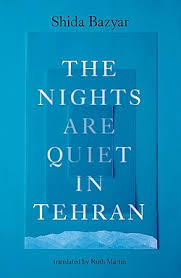
It sometimes feels likes a writer has used their work of fiction as a cathartic exorcism of their demons. The Nights are Quiet in Tehran feels like Shida Bazyar is laying bare parts of her own upbringing as the child of political refugees from Iran living in Germany. This gives the book a warmer, more personal touch than might have been achieved by another.
This book plays with form, switching 4 times between time periods and narrators as we follow the lives of Behzad, his subsequent marriage to Nahid, and then the stories of their children, Laleh and Morad. Each voice offers a different perspective on the ripples of Behzad and Nahid’s revolutionary spirit in their youth and subsequent escape from Iran.
The 4 epochs take us through Iran’s recent political history starting with Behzad’s revolutionary youth as a communist in the time just after the fall of the Shah. These first chapters are the most overtly political but set the stage for the diminished Behzad we see through Nahid’s eyes, a far cry from the confident warrior she first meets.
With Nahid, we learn about the family’s settling in Germany, and the difficulties that come with it. They are neither German, nor do they relate to other pro-Shah Iranian exiles. We see them making friends with a “revolutionary” German couple, who seem hellbent on proving that they can pave a road with good intentions. The unfeeling asylum system Nahid and Behzad face while eking by a meagre existence feels as though these chapters could have come from a documentary about today as much as a depiction of late 1980s Germany. These elements combine to show the political fizz of this time, while preparing the “end of history” 1990s.
Jumping ahead to Laleh, we see the challenges faced by the eldest of their offspring. Old enough to have some memories of their life in Iran and to cling to those core beliefs, she’s also obliged to grow up quickly, acting as her parents’ translator. In the later of her chapters we see her family’s return to Iran on holiday, where she learns that she’s not as Iranian as she believed herself to be. It’s a more emotional read than the previous 2 narrators, perhaps drawing on Bazyar’s own experiences?
The final jump cut we see through the eyes of Morad, and a jump cut it is. With the earlier characters, we can feel more of a through line, but with “Mo” we feel the acceleration of the world in the late ’00s and the disorientation that it brings. The text feels pacier and punchier, giving us as readers less time to feel where we are. We see the Iranian uprisings of 2009 mediated through the internet and his eyes and the early seeds of the 2010-2011 period of popular uprisings across North Africa and South West Asia.
It’s a sweeping tale, and is effectively told. I read this as an audiobook, which cleverly had a different narrator for each epoch giving it more of a living history feel.
