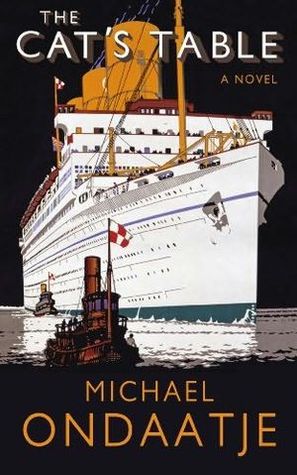
Weaving fragments of timelines is always a risky move for a writer. Moving backwards and forwards through the protagonist’s life can be confusing and gimmicky, taking a skilled story-teller to avoid us asking if it would be a better plot if it were linear. With Michael Ondaatje, we’re in such talented hands. The Cat’s Table weaves a slow, reflective tale of a group of friends, migrants from Sri Lanka to Britain and from there the wider world. Ondaatje uses the same spatial anchor to keep us attached to the throughline as he did with the English Patient, the main timeline remaining trapped like a bottle episode, here the tale of the adolescents’ 21-day trip on a ship, while showing how their lives as adults evolve.
The heaviness of lost innocence shapes this story. The joyful playfulness of Ramzan, Michael, and Cassius as the thick as thieves, quite literally at points, trio on the boat contrasts sharply with them as men in the wider world. We slowly come to understand how a seemingly short time together on the trip impacts their adult lives. Ondaatje’s literary explorations of unresolved guilt & grief are entwined here, not just for our narrator, Michael, but also in other peripheral characters, who come in and out of his life. These threads are delicately weaved together, as the tapestry of disparate lives is gradually unveiled to us.
In a time where immigrants are demonically dehumanised, “othered” to mere statistics and soundbites for new cycles and scapegoating, The Cat’s Table offers something deeper. We cannot escape the interconnectedness of our lives. I am because we are.
