 Decades ago, when I first heard the term “footbinding,” I thought it simply meant that the feet of Chinese girls were wrapped tightly to keep them small and delicate. Then when I learned that there was much more to it than that, I realized it was awful but didn’t give it much more thought. After reading Snow Flower and the Secret Fan, which goes into detail about how girls as young as 5 or 6 were subjected to the practice, I’m truly horrified. If you aren’t familiar with the custom, a girl’s feet were wrapped so tightly as to break their bones and force the feet to reshape into what was known as “lotus feet.” The resulting foot had an abnormally high arch and was ideally 10 to 11 centimeters long. Girls endured daily agony for at least two years while their bones broke and their feet reshaped, and about ten percent of girls died from septic shock caused by infections. In some cases, adults experienced chronic pain or disabilities, and even the lucky ones had reduced mobility and bone density (imagine walking on a foot folded in half all the time). As to why a mother would force her child to endure something like this, knowing from first-hand experience the risks and the agony, footbinding was the only way a Chinese girl could ensure a respectable marriage; typically, only servants had “big, floppy feet.” Since a woman’s worth was tied to having sons, footbinding was an economic and social necessity, and women with small, “perfect” lotus feet could rise above their station. The practice didn’t die out until the early 20th century.
While Snow Flower and the Secret Fan isn’t specifically about footbinding, the custom plays a huge role in the lives of the main characters and helps explain their mindsets and motivations. As the narrator, Lily, explains, “The binding altered not only my feet but my whole character, and in a strange way I feel as though that process continued throughout my life. . . . By the time I was forty, the rigidity of my footbinding had moved from my golden lilies to my heart, which held on to injustices and grievances so strongly that I could no longer forgive those I loved and who loved me.”
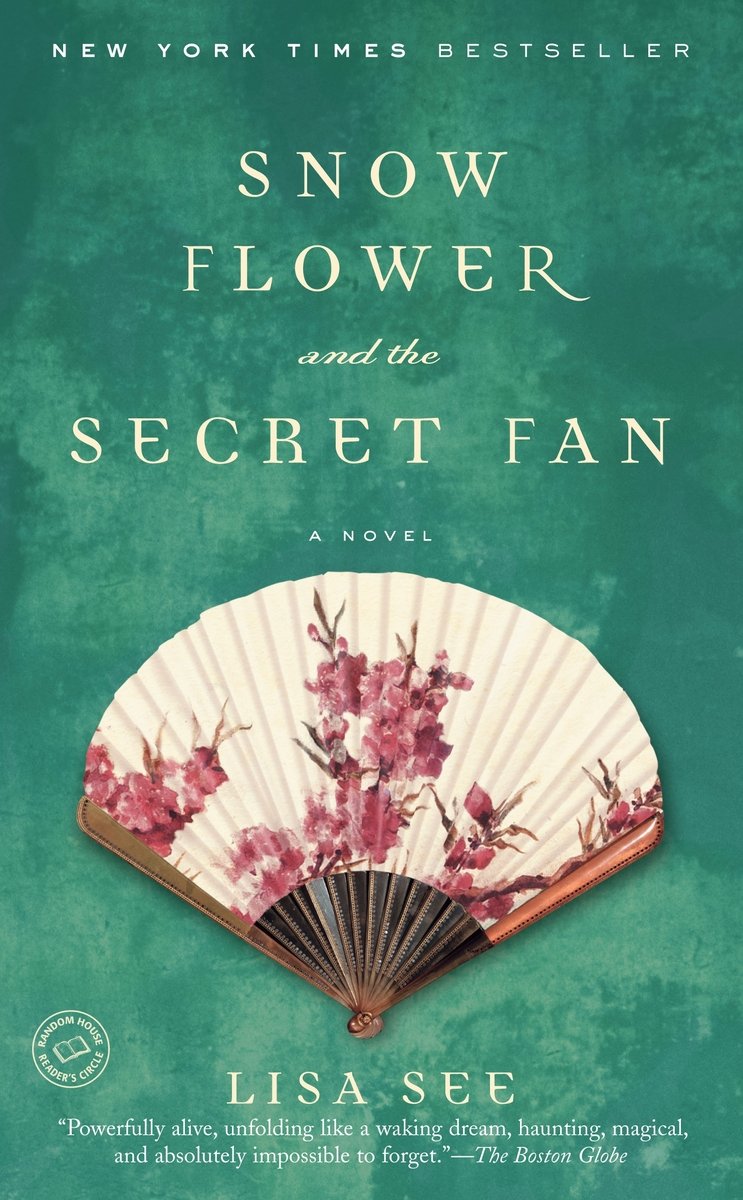
The story is about Lily, the daughter of a farmer in mid-19th century China, whose destiny becomes tied to Snow Flower, the daughter of a noble family in the region. A matchmaker recognizes the beauty of Lily’s feet and determines that, after footbinding, her beauty could result in a match well above her family’s current station. In addition, she thinks she can make a laotong match for her, meaning she would be tied to another young girl (Snow Flower) for life. This would be an honor that Lily had never dreamed of, and the thought immediately excites her. When she meets Snow Flower for the first time, she is drawn to Snow Flower’s beauty and free spirit. Being from a noble family, Snow Flower is also much more highly educated, and Lily is entranced by Snow Flower’s ability to effortlessly write in nüshu, a secret form of women’s writing that Lily also learns. They exchange messages on a fan, and Lily observes, “Her words both frightened and exhilarated me. She was clever. She had much more learning than I did. But this was not the scary part. In every message she spoke of birds, of flight, of the world away. Even back then, she flew against what was presented to her. I wanted to cling to her wings and soar, no matter how intimidated I was.”
The book follows the pair’s relationship as they prepare for marriage and into their married years. The reader learns that Snow Flower’s life isn’t as blessed as it seems, and in fact, Lily is the one who prospers. It follows the pair as they become mothers, and all the heartbreak and social implications that go along with that, and through the horrors of the Taiping Rebellion, where they both need to flee from their homes into the mountains. Sadly, as Lily prospers, her heart hardens toward the reality of Snow Flower’s situation, and their laotong relationship suffers.
By the end of the story, it would be easy to condemn Lily, but I couldn’t get past the pervasive loneliness that every woman in this novel experiences. Yes, some of them had a laotong and most had “soul sisters,” but how do you truly love and support another woman when you have been taught for your entire life that women are worthless? At one point, Snow Flower says, “Lily, we are worthless. . . .You know that, don’t you?” To which Lily can only think to reply, “Women are the mothers of sons.” For Lily and Snow Flower, alone in their homes with husbands who may or may not love them, and mothers-in-law who may or may not treat them decently, and with their one devoted friend miles away, how does one endure? For Lily, she learned to accept what she had been taught, that a way to earn love and power was to provide a strong male heir–and if that worked for her, it must work for every woman.
This story is heartbreaking but beautiful and I highly recommend. For more by Lisa See, check out The Island of Sea Women, which I consider a perfect historical fiction.
