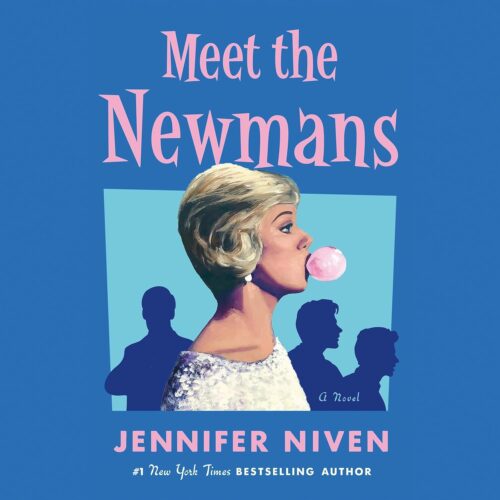
Jennifer Niven’s titular Newmans are a family comprised of father Del, mother Dinah and sons Guy and Shep. They’re a typical American family, or at least they play one on TV. The setting is 1964, and Meet the Newmans has been on radio and then television for over a decade, presenting wholesome entertainment for all ages. But in the turbulent 1960s, the Newmans are starting to seem more than a little out of touch. When a brutal pan appears in the New York Times, and salacious rumors start cropping up in the Hollywood press, the network makes it clear to Del and Dinah that their show is on the chopping block unless it can get new sponsors and attract a bigger, younger, audience.
Del, the writer and director of every episode of the series, starts to plan for a big season finale, but before the taping, fate intervenes, forcing the rest of the family to step up. Dinah, feeling chastened by an interview with a young feminist journalist from the L.A. Times, decides to assert herself and write the finale in her husband’s place. Guy, who’s hiding a couple of big secrets from his family – including one about the real nature of his relationship with his “best friend”- finally gets the chance he’s always wanted to step into the director’s chair. Younger brother Shep isn’t much of a help, but to be fair, he’s trying to balance his role on the show with his burgeoning pop music career and the devastating news that his ex-girlfriend is pregnant with his child.
The midcentury setting and the many spinning plates of the plot combine for an appealing set-up, but unfortunately Niven fails to deliver on the novel’s promise. She commits the cardinal sin of novels set in the past, condescending to the people who lived then and implying that their lives would’ve been so much better if they’d just thought, felt, and acted like those of us who live in the enlightened present. This is most clearly exemplified in the painfully didactic conversations between Dinah and Julia, the young journalist who eventually agrees to help write the script for the new season finale. While it makes sense that Julia would be more of a feminist than the older Dinah, it’s less defensible that she sounds indistinguishable from a 2020s feminist activist.
Things aren’t really any better in the Guy and Shep plotlines. Guy’s worry about what will happen if his family and the show’s audience find out about his sexuality is a serious topic, but it is well-trodden territory and has been handled so much better by many other authors. Shep is similarly caught in a cliche “nobody take me seriously as an artist” plot and a rather unflattering “I’ve been a playboy but now I’ve met the one woman I want but can’t have” bit of drivel, the resolution of which truly feels like it would’ve been science fiction in 1964. Niven appears afraid to really confront the possibility of her characters ending up unhappy, making the conclusions of their stories inevitable and dull.
Meet the Newmans is a novel obsessed with the idea of shaking up the past, which makes it sadly ironic that it fails by being so conventional.
