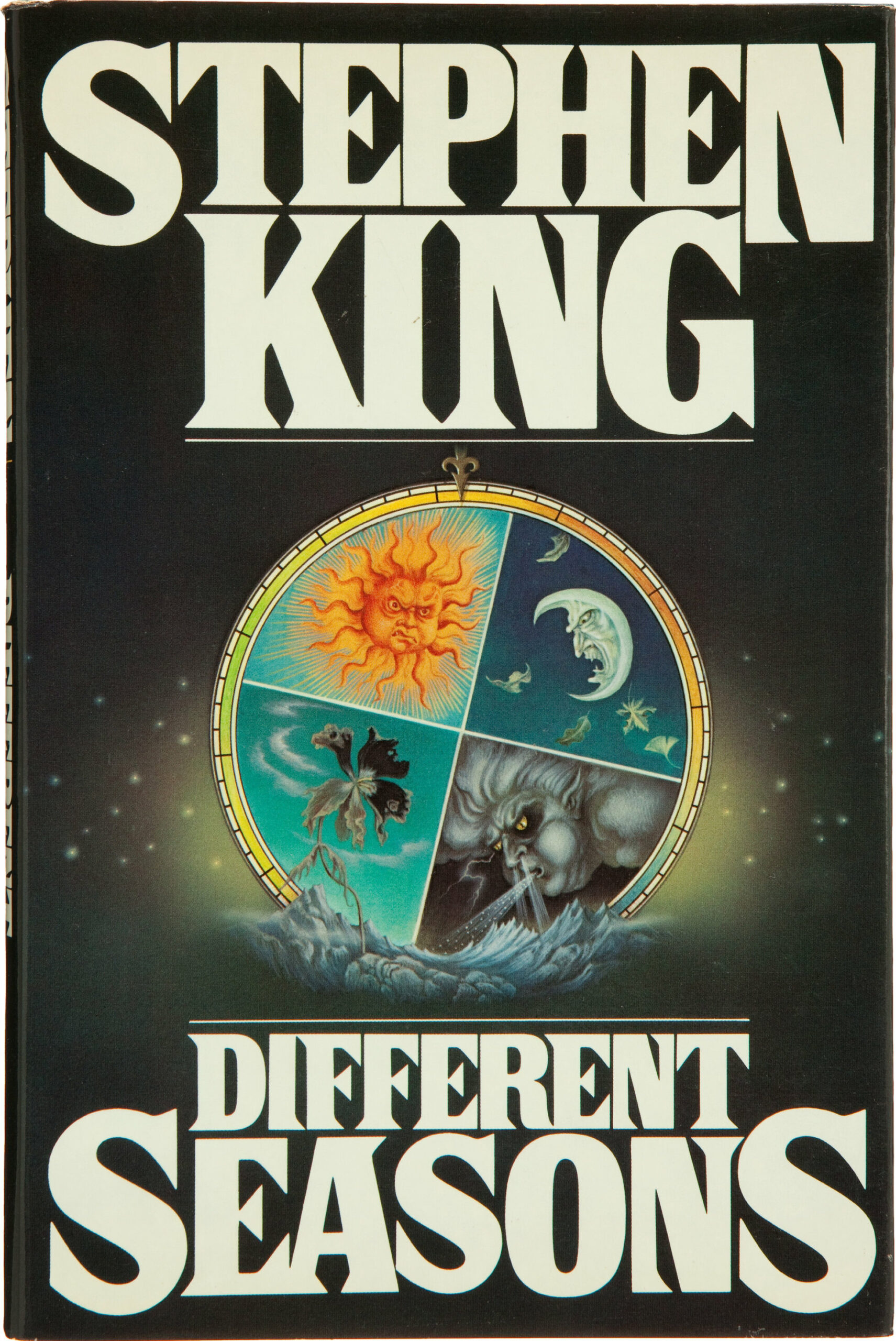
 At least 30 years ago I read The Shining and really enjoyed it, so I’m not sure why I never picked up another book by Stephen King. Probably it’s because I’m not a huge horror fan, although Shirley Jackson’s Haunting of Hill House started to change my mind about that. Recently, a friend of mine convinced me that I should try Different Seasons, and knowing that it contained the novella that was the basis for The Shawshank Redemption, I thought, “Yes! Excellent idea!”
It’s always a bit risky reading the source material for a movie you know and love, isn’t it? How will they compare? In the book vs. movie debate, I find that the one you experience first often becomes your preference. I was thrilled, then, to find that Rita Hayworth and Shawshank Redemption is a near perfect novella, and while this isn’t a review of the screenplay, I’m compelled to call out that Frank Darabont did an exceptional job adapting it for the screen, keeping the essence of the story while amplifying certain plot points and characters to make them more cinematic.
I’m not going to summarize the plot, because there are maybe 3 people in the English-speaking world who haven’t seen the movie. The essence of the story is hope, even in the darkest of places, and freedom. The narrator, Red (who is very specifically Irish in the novella, but yeah, try to not hear Morgan Freeman’s voice when you read), talks about how Andy never really adopted a “prison mentality,” and wore his freedom “like an invisible coat.” Red goes on, “He never developed the walk that men get when the day is over and they are going back to their cells for another endless night–that flat-footed, hump-shouldered walk. Andy walked with his shoulders squared, and his step was always light, as if he were heading home to a good home-cooked meal and a good woman instead of to a tasteless meal of soggy vegetables, lumpy mashed potato, and a slice or two of that fatty gristly stuff most of the cons called mystery meat. . . that, and a picture of Raquel Welch on the wall.” Ironically, Andy’s ability to suppress any hope of release is what allows him to cope, and when Tommy Williams comes along and offers a sliver of hope that Andy could have grounds for a retrial, it “produced the key that unlocked the cage and the tiger was out, willy-nilly, to roam his brain.”
This story is just so lovely. It’s dark at times, but I’m hard pressed to think of many closing lines that make me feel as sanguine as Red’s: “I hope Andy is down there. I hope I can make it across the border. I hope to see my friend and shake his hand. I hope the Pacific is as blue as it has been in my dreams. I hope.”
The Body is King’s semi-autobiographical novella about four 12-year-old boys going in search of a dead body, which was adapted into the much-beloved classic Stand by Me. The movie is a pretty straightforward adaptation that remains true to the novella, both in plot and feel. The four boys have tough home lives, but they also live in an era where kids could go out and play and be gone for hours without parents hovering over them (although in their cases, that may have been more a reflection of their parents’ neglect). King captures this magic (a very different kind of freedom) when Vern says, “This is a really good time,” and the narrator, Gordie, notes, “and he didn’t just mean being off-limits inside the dump, or fudging our folks, or going on a hike up the railroad tracks into Harlow; he meant those things but it seems to me now that there was more, and that we all knew it. Everything was there and around us. We knew exactly who we were and exactly where we were going. And it was grand.”
While it’s implied in the movie, the story gives more context to King’s development as a writer, including two stories-within-the-story: “The Revenge of Lard-Ass Hogan,” the tale of a pie-eating contest gone wrong that Gordie shares with his friends around the campfire in the film, and “Stud City,” a piece of melodrama that isn’t very good but is auto-biographical to the Gordie character (Autobiography within autobiography. It’s getting rather meta). The Body is about nostalgia and friendship, but also about writing as an outlet for sharing the things that are difficult to express. In the introductory paragraph, the adult Gordie talks about how the most important things are the hardest to say. “You make revelations that cost you dearly only to have people look at you in a funny way, not understanding what you’ve said at all, or why you thought it was so important that you almost cried while you were saying it.” That paragraph hit me hard. My senior-year high school English teacher said something similar to her class once, prefacing it with, “You might be too young to have experienced this yet. . . .” Damn, Stephen King and Mrs. Canavesio, you were both spot on.
Apt Pupil is the reason this collection gets 4 starts instead of 5 from me, and also why I need to be selective about any future King that I choose to read. I simply didn’t care for it. In this novella, 13-year-old Todd Bowden discovers that his old German neighbor is a Nazi-in-hiding and proceeds to blackmail him into sharing gruesome details about concentration camps. Todd’s obsession with prison camps and torture is grotesque, reaching the level of fetishism. It made me uncomfortable, and while I understand that is intentional, it didn’t pay off for me into anything interesting or worthwhile. Not too far into the story, the Nazi Dussander tortures and murders a stray cat, in case the reader was under any illusions that he had reformed into a nice old man. I honestly thought about quitting the story at that point but kept going, and I can’t really say I’m satisfied with my decision. By the end, Todd is describing the events as “something that just happened,” which is patently untrue. Nothing about this situation just happened, starting with the lengths he goes to in order to uncover Dussander’s identity. At 180 pages, Apt Pupil is the longest story in this collection, and if it had wrapped up in half that length I might feel more charitable toward it.
Breathing Method is the shortest novella in the collection, and the only one of the four that hasn’t been adapted into a film (to my knowledge). This one is the closest King comes to including a horror story, although I like to think of it more as a ghost story. This is another one told as a story-within-the story. The narrator, a lawyer named David, is invited to a mysterious gentleman’s club (the kind where they have drinks and tell stories, not the kind you’re thinking of) by a senior partner. At one of his visits, a physician tells a story about a patient named Sandra that he knew in the 1930s. She was pregnant with an illegitimate child but determined to give birth to a healthy baby, in spite of the obstacles in her way (money, society, you know the drill). The physician teaches her a breathing method (likely something similar to Lamaze, though that wasn’t introduced until the 1950s and wasn’t popular until the 1960s and 70s). Without spoiling the “fun,” I will say the breathing method becomes critical to the delivery of the baby, overcoming deathly obstacles for the mother. It’s a simple story but good if you’re in the mood for a nice, old-fashioned campfire tale.
To sum it up, I adored half of the stories in this book, enjoyed one more, and didn’t have much patience for the fourth. I should also mention that as I read Breathing Method, which is the final story in the collection, I realized it was the first entry that included a woman as a major character. Given the settings of Shawshank and The Body, it’s understandable, and I’m not exactly criticizing King. However, 450 pages is a long time to wait for a compelling female character to show up, which might explain why I was getting a little weary even as I was (mostly) enjoying myself. If I had skipped Apt Pupil, I probably wouldn’t have felt that way.
