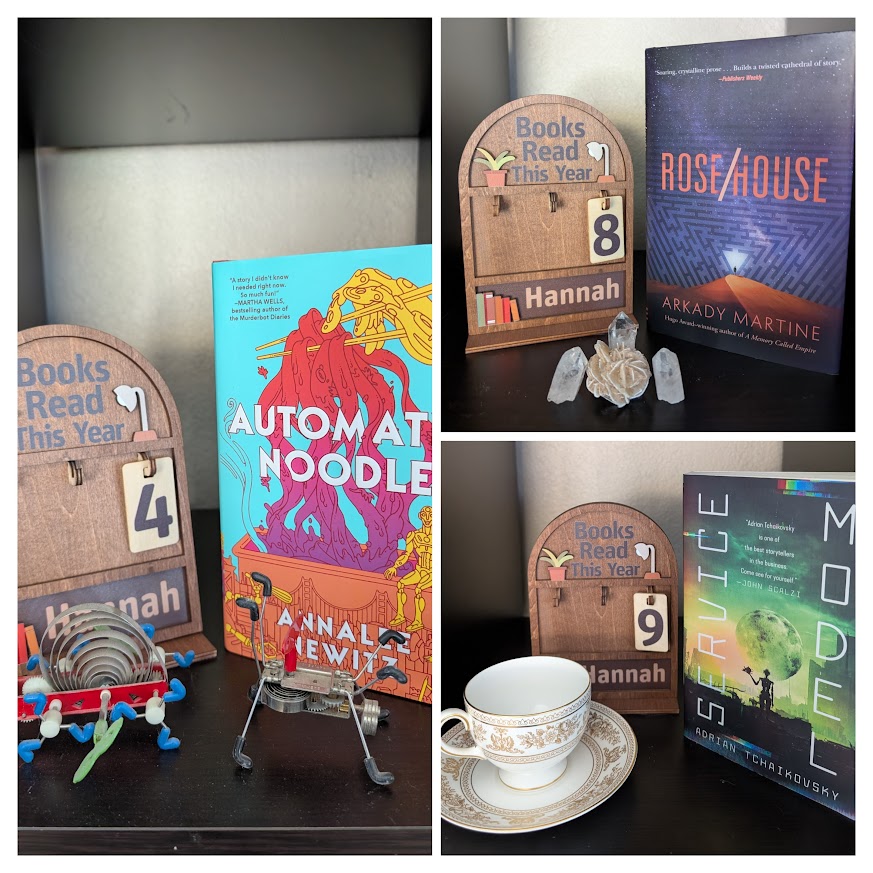
The end of January to the very beginning of March has had the good fortune to have three excellent books looking at robots, AI, sentience, autonomy, finding meaning, and limitations on the flawed way humanity has programmed robots/AI. While setting up this post, I just realized all the author’s first name start with A. Huh, kind of interesting.
First up was a novella by Annalee Newitz, Automatic Noodle. This is the most fun and lighthearted of the bunch. It is the year 2064, a few years after California has bloodily fought for independence from the United State. A difference between the two countries is that in the US robots are owned and strictly regulated. In California they are allowed to be independent beings, though there is a portion of California society who is not happy with this status quo.
Staybehind is a humanoid robot that served in the war. Sweetie was designed to be a human facing robot for a bank. From the waist up appears to be a human female but below has multiple legs on rollers. Cayenne with a cephalopod body that was originally designed for search and rescue and is now a food taster and preparer. And Hands, a robot that was never meant to be human facing with a barrel shaped food mixer for a headless torso and a study anchor for multi-jointed actuators for chopping and cooking. They all work for a to go restaurant that has changed menus many times as the owners’ flip the business for shady reasons. At the start of the book, the robots have just awakened from a several month sleep and discover the owners of the restaurant have fled across the border and they are left in limbo.
What follows is a tale of robots trying to establish their own restaurant, dealing with paying off personal debt, figuring out what they want and how they prefer to present themselves going forward. It also includes the struggle of opening a new restaurant and dealing with the almighty algorithm to get humans to their business. When review bombing looks to tank their budding enterprise, the robots have to get innovative.
Arkady Martine’s novella, Rose/House is a locked room mystery with an AI that truly feels alien. In Martine’s setting, putting an AI in a house is common. However, the entirety of Rose House is the artificial intelligence. It is “… infused in every crevice and corner with a thinking creature that is not human”. Locals consider it haunted. Rose House does not have a trace of humanity; everything comes back to logic and how the house interprets situations within its logic. Using nano drones, the house can imitate a hand on a shoulder. To express emotion, it uses sounds that mimic nature (water, wind, sand grains falling down a dune) in cascades and crescendos to imitate laughter and disdain. All together making it one of the most alien AI’s I have read.
When Rose House’s creator Basit Deniau died, he insisted on his crematory remains be crushed into a diamond and displayed in Rose House. A house that also is the sole repository of Deniau’s archives of architecture, and AI design and integration with buildings. A further stipulation is that only one person, Dr. Selene Gisil, is allowed to visit one week a year to gain access to the archives. When Rose House calls local authorities to report a dead body, aside from Deniau’s diamond remains, it is a mystery as to how the victim got into the house in the first place, as Dr. Gisil is on the other side of the planet. Once Detective Maritza Smith, gains access to the house to inspect the dead body, she finds herself getting sucked into the mystery that is Rose House itself.
Rounding out the triptych is Adrian Tchaikovsky’s novel, Service Model. Charles, the gentleman’s gentleman robot valet is here to care for its master’s every need. Laying out new clothing, preparing a proper cut of tea, arranging the travel schedule for all their master’s appointments. Living in the manorial system means that everyone’s needs are met by robots. Robot cooks, maids, footmen, gardeners, and machinists to keep the everything mechanical up and running. Along with the household majordomo AI to orchestrate it all. A human’s every need is taken care of.
One day while working through its daily task list, Charles comes to the horrible realization that it has slashed its master’s jugular, killing him, but without any knowledge in its system of having done so. Assuming something has become defective, Charles heads to Central Diagnostics for a checkup and repair. Along the way, Charles sees that the manorial system has collapsed. Houses have broken window or are boarded up. Gardner robots frozen in place as plants grow around and through them. Valet robots standing at the end of driveways to usher in guests that are never coming. However, they can’t leave their post as the last command given by their master was to wait. Arriving at Diagnostics, Charles discovers it in complete disorder. It is clear that robots have been waiting years to get in and there are no humans to authorize anything.
At Diagnostics, Charles meets the Wonk, a defective robot that encourages Charles to take a new name. And thus, it takes on the name Uncharles. All Uncharles wants is to find another human that it can be a valet for. It was programmed that way and wishes to return to its’ duties. The Wonk assists Uncharles in this endeavor but also pushes it to consider its’ wants, and to help the Wonk figure out why everything has happened, the collapse of humanity, robots stuck in programing loops offering tea to humans who will never come and fighting endless wars based on last orders. Roving through an apocalypse wasteland, Uncharles and the Wonk seek meaning and where to go from here. But there are no easy answers, and the final reveal is a chilling look at how we as a society treat the scales of justice.
All three books are 4 stars but if they were reviewing individually, Service Model would be 5 stars.
