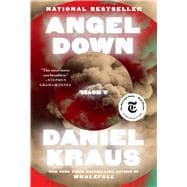
Private Cyril Bagger has managed to survive the unspeakable horrors of the Great War through making sure he’s as far from the carnage as possible; and if that’s digging the latrine trenches that’s fine by him; at least he’s not possibly getting blown to bits. But his survival instincts also mark him as one of the five most expendable people in his company, and therefore perfect for a suicide mission: venture into the perilous No Man’s Land with the other four to euthanize a wounded comrade. Then maybe the strange crying noise will stop and that blinding light will go out.
What is waiting for them, however, is not a wounded man in need of oblivion, but a fallen angel, most likely struck down by artillery fire. The angel may hold the key to ending the war, if only the soldiers can suppress their own selfishness and work together. But as jealousy, greed, and paranoia take hold, the group is torn apart by their inner demons, threatening to turn their angelic encounter into a descent into hell.
This book reminded me of DarkMateria’s “Picard Song”, especially the lyrics:
“He just kept talking, in one, long, incredibly unbroken sentence
Moving from topic to topic
So that no one had the chance to interrupt
It was really quite hypnotic”
Because this book was a 288 page, multi-chaptered, run-on sentence, told almost entirely as Cyril Bagger’s internal monologue. And I don’t know what I thought of it; either the writing style, or the book. For an action-acked, dialogue- and internal monologue-heavy story that said a lot about the world, it also said nothing, went nowhere and meant nothing. The one thing I do know is that Kraus comes across as extremely disdainful of both war and religion. If you want a brutal, unvarnished, unglorified look at the horror of war and all its ugliness, this is the book for you. You want a book that stresses that so much bloodshed is the result of little men seek war to make up for their own inadequacies, this is the book for you. You want a book that shows why in the Bible all conversations with Angels start with the Angel saying, “Fear Not”, this is the book for you. This is also a book that states the Angels are not for Mankind; they just are what they are, and what they are is God’s tools. If there is even a God; Kraus seems to insinuate that Heaven, Hell, God, the Great Adversary; this are all just words used by Humanity to make sense of why the world is they way it is. I suppose Bagger shows every cynic has a heart of gold, and that Arno, the young impressionable mascot of the company who Bagger reads Tarzan serials to nightly, is his conscience. Unique plot point that the Angel appears as a different woman to each of them (though a Madonna in scarlet? Really?). And Bagger is the one that never really wanted anything from the Angel? If it’s really an Angel; or is the insinuation that it’s a Demon, or that there technically is no Heaven or Hell, Angel or Demon; there is just one place and one set of creatures and humanity slapped labels to explain why they act the way they do sometimes. But God is Adversary as well as Savior. It does make some kind of strange, sick sense that the Spanish Flu Epidemic and World War One were the kickoffs for a slow-moving End Times.
As I said, I can’t say what I honestly thought of the book; I don’t hate it, but I can’t say that I necessarily loved it. I might be interested in picking up another of his works (maybe Whalefall) to see if all of his works is this level of bleak cynicism, or presented as one long run-on sentence. Suffice to say, run-on sentences are not my favorite way to read books.
