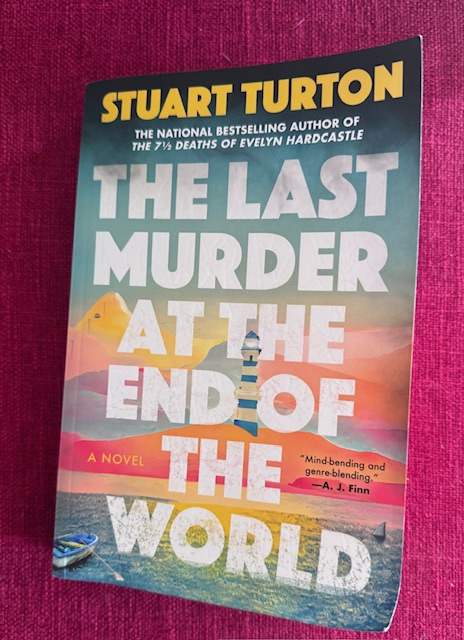
 I loved Stuart Turton’s The 7 ½ Deaths of Evelyn Hardcastle (except for one aspect of the ending) so I picked up his The Last Murder at the End of the World. I didn’t like it quite as much as his other book, but it was a solid and diverting read.
Slight spoilers ahead.
The story takes place on an island that is surrounded by a deadly fog. Almost 100 years before, the human population created this dangerous fog (it’s never said how or why) and now this little island houses the only humans left in the world. Among them is Emory, an inquisitive, indefatigable sort who ends up in the role of detective due to her questioning nature.
This is somewhat a post-apocalyptic world, obviously, but there is a great deal of joy and positive communal living among the villagers. Revered by the villagers are three Elders, Thea, Niema, and Haphaestus (who is Niema’s son). As the story unfolds, we discover that the Elders are the only humans among the populace; the rest of the villagers were created by humans 40 years before the apocalypse to be soldiers, and then later essentially made servants. Everyone has an internal, omniscient voice/presence inside their heads called Abi. Abi can speak directly to the humans and villagers and the humans and villagers can speak to Abi (usually to ask questions). Until the time of this story, the villagers did not know they aren’t human or that they are only valuable as workhorses. They do their work with good spirits, although at curfew they fall asleep and wake up in the morning with no memory, except they are often covered in scratches and bruises.

Niema is the most revered elder and serves as the island’s teacher. All of the elders are involved in mysterious experiments, which the reader doesn’t learn much about until later in the book. As the story opens, Niema is planning some critical experiment that could either descend peace on the whole population, or could end in death and disaster. One thing she plans to do is keep the villagers awake one night and tell them the truth of who they are. It is clear the other two Elders are not keen on this plan.
The society has other mysterious aspects. A company called Blackheath existed in underground rooms and tunnels on the island before the apocalypse; when the fog came, all the humans except the three Elders were put into stasis in pods underground until such time that the fog can be figured out and overcome. The three Elders that oversee the villagers have lived around 140 years, working on how to eliminate the fog and bring humanity back.
Over the course of the story, we learn that all of the Elders, especially Niema, have done some terrible things, including killing some of their fellow humans. Emory, the heroine of our story, is filled with anger as she discovers the Elders’ secrets.
One morning, the villagers wake up to find Niema stabbed and her head crushed in by a fallen beam. Who was her killer? Emory, her daughter Clara, and her father Seth work together to unearth the mystery. Emory is the primary driving force behind the endeavor, and it is ultimately she who figures out the murderer and the details of the night Niema died.
The story gets kind of convoluted in places; not unlike The 7 ½ Deaths of Evelyn Hardcastle, Turton sets up a complicated world with complicated systems that can be hard to follow. Even at the end, there were a few things I wasn’t sure of. But I enjoyed the ride nonetheless. The ending is solid and all the world details are creative and interesting. I took a reading break last month so it took me a while to get back into the Cannonball swing, but for my second review, I do recommend this book.
