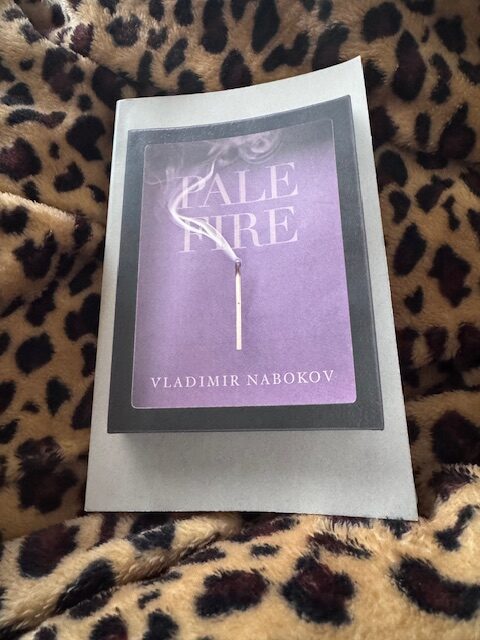
 “I’m not smart enough for Nabokov” I thought to myself as I began his hilarious and sharply observed novel Pale Fire. But then I remembered a saying I recently heard: I don’t have to understand something to appreciate it. And I understood more than I expected to.
Like Lolita, Nabokov has written an unreliable narrator, full of himself and driven by unrelenting desire, in this case, the desire to have ownership of his poet neighbor’s final poem. The narrator, Dr. Kinbote, opens the work with a foreword highlighting his relationship to the poet, John Shade, and the role he has undertaken to comment on the work, also called Pale Fire. After the foreword, Kinbote shares the poem itself in four cantos, after which the book turns to Kinbote’s extensive commentary.
Kinbote is a scholar at the nearby university at which John Shade also works. He becomes fanatically enamoured of the older poet, and purposely seeks out where Shade lives to rent the cabin next door. Shade’s wife Sybil is no fan:
I was to learn later that when alluding to me in public she used to call me ‘an elephantine tick; a king-sized botfly; a cacao worm; the monstrous parasite of a genius.’”
Later, one of his colleagues criticizing Kinbote’s ownership of Shade’s final poem, avers Kinbote “is known to have a deranged mind.” Despite all this criticism, Kinbote is supremely convinced of his own importance. This is because he believes Shade’s poem is a homage to Kinbote’s homeland Zembla. On walks and encounters that Kinbote pretty much forces on Shade (as much as Shade wavers between avoiding Kinbote and being collegial), he regales the poet with tales of Zembla, its heroic king Charles Xavier who went on the run after a revolution, and the determined man nicknamed Gradus who was sent after the king to kill him.
In Kinbote’s commentary, he strains to find connections to his influence. He will take a single word, and desperately find some way to connect it to his tales of Zembla and its king. It is soon clear to the reader that Shade has no regard for Kinbote’s tales at all, and certainly found no interest in the king’s journey. Later in the book, Kinbote claims he is the fugitive king, who fled over the ocean to come to America and escape his enemies. It’s quite funny how it comes about, as Kinbote lavishly praises the king in the third person for a great deal of the narrative, when suddenly he uses the first person and reveals what he claims is his true identity.
Kinbote’s indignation and pedantry as he tries to see his influence on the poem is hilarious. He describes early in his commentary:
Nevertheless the urge to find out what he was doing with all the live, glamorous, palpitating, shimmering material I had lavished upon him, the itching desire to see him at work (even if the fruit of his work was denied me), proved to be utterly agonizing and uncontrollable and led me to indulge in an orgy of spying which no considerations of pride could stop.”
Or he says after Shade has died:
The most striking characteristic of the little obituary is that it contains not one reference to the glorious friendship that brightened the last months of John’s life.”
At one point he even calls it “my poem.”
It’s also amusing to notice Kinbote’s undeniable attraction and random references to capers with young men. He talks about “wrestling” his students and admiring the physique of strapping pillars of masculinity. In his stories about the king, he regales us with the king’s randy bedding of multiple men, even though he has a wife. At the end of the book, when he assumes yet another alias, he comments, “I may turn up yet, on another campus, as an old, happy, healthy, heterosexual Russian, a writer in exile, sans fame, sans future.”
The book centers on a man who wants to be important, who wants to inspire art, but throughout the narrative the reader clearly sees his desperate contortions to make himself the protagonist of Shade’s poem and even his life. There is a lot of humor and of course stunning writing in Nabokov’s book. I definitely appreciated it.
