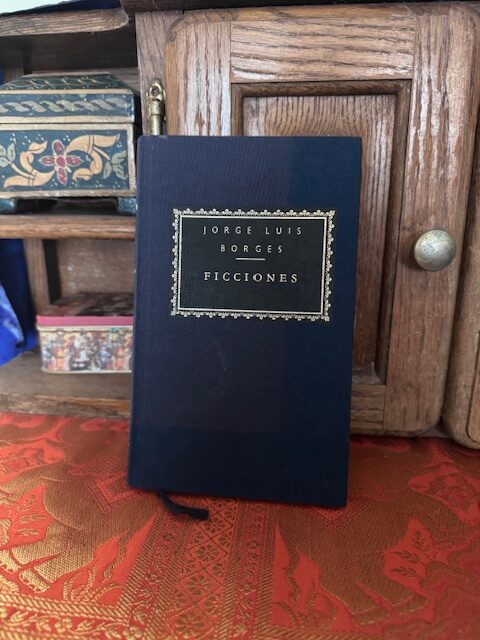
 Long ago–25 years I think–a past friend gifted me Jorge Borges’ Ficciones, a collection of short stories by the great Argentinian writer. My friend was a brilliant thinker and writer, and when I glanced at the book after he gave it to me, I thought it was suited to him but not to me. Like my last review of Nabokov’s Pale Fire, I was intimidated and didn’t feel smart enough to understand what probably came easy to my friend. So I put the book aside for a quarter century (oy, I’m old).
I planned out my books for CBR 18 ahead of time, like I did last year, and wanted to challenge myself more. So I picked up Ficciones with trepidation and found I was both right and wrong about its complexity: I didn’t quite grasp all the philosophy behind the stories, but I grasped enough to appreciate and timidly enjoy them.
In the introduction to the book, John Sturrock states: “Borges’ fictions are narrative at its purest; they contain no psychology. His ‘characters’ are really no more than proper names or the embodiment of an idea, without an inner life to call their own.” This is why I struggled with the book at times–I am used to deeply character-driven books and don’t quite have the mind to take in a character as representative of a particular philosophy.
Nonetheless, I did pick up themes. Borges returns many times to the concept of time, of naming things, of labyrinths, of language, of metaphysics, of illusions turned into life, of the manifestations of God, of limitlessness, of the nature of reality, that there is simultaneously both infinite complexity and infinite reduction to a single idea or object that contains all knowledge.
In one of his more famous stories, Borges envisions an infinite library containing all books of which there are no duplicates. He talks of the books’ uniform elements: certain punctuation and the individual letters of the alphabet, which some argue means that the order is “accidental and that books in themselves mean nothing.” In this vision of all books, Borges’ narrator states, “To me, it does not seem unlikely that on some shelf of the universe there lies a total book.” This is one of many instances where the infinite All is also capable of being embodied in a single element. He finishes with the thought, “The Library is limitless and periodic.”
The image of labyrinths return again and again. In different stories, Borges refers to a book’s “labyrinth of letters” (not unlike his own writing, with its many twists and turns). He speaks of reality as “a labyrinth, but it is a labyrinth plotted by men, a labyrinth destined to be deciphered by men.” A character in one story recounts an ancestor who created mazes “in which all men would lose themselves…nobody ever found his labyrinth.” He talks of “circular labyrinths” where people in real life are callbacks to characters in fiction.
There are more infinities and discussions of all being one. In one story where a character is in search of someone, he writes: “The conjecture that the Almighty is also in search of Someone and that Someone in search of some superior Someone…and thus on to the end–or better, endlessness–of Time.” The story closes with the thought:
Everything in the intelligible heaven is everywhere. Anything is all things. The sun is all the stars, and each star is all the stars and the sun.”
In another story about what he calls a “chaotic novel” he relates, “Your ancestor did not think of time as absolute and uniform. He believed in an infinite series of times, in a dizzily growing, ever spreading network of diverging, converging and parallel times.”
Interestingly, Borges notes elsewhere, “There is no intellectual exercise which is not ultimately useless.” Borges undermines his own stories while energetically creating them. But still, he says, “The truth is that we all live by leaving behind; no doubt we all profoundly know that we are immortal and that sooner or later every man will do all things and know everything.” This knowledge is not separate from the intellect, but it is understood that there is an immortality where humans know everything, and this transcendence is not so much about meaning as it is the infinite cosmos.
I am very glad I read this book, and silently thank my friend for having enough confidence in me that I was capable of understanding some of its magic.
