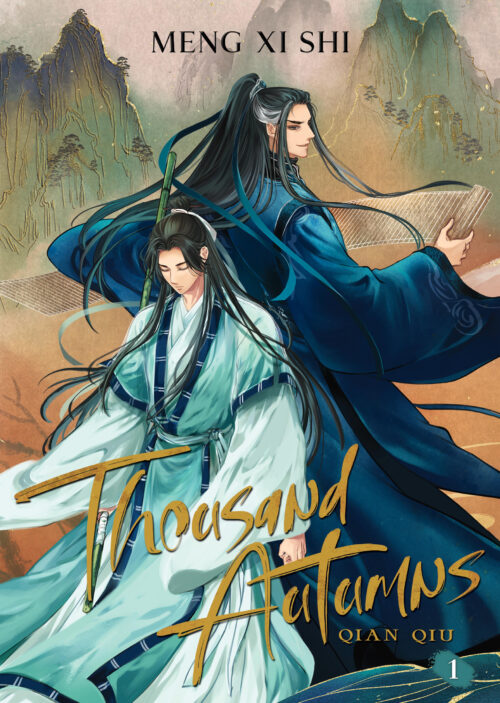
 Yan Wushi is a cynic as well as a master cultivator and leader of a demonic sect. When the head of a Daoist sect, Shen Qiao, loses a duel and is badly injured, Yan Wushi decides to take the injured man in and see if he can corrupt him. Their clashing philosophies towards the world put them on separate paths, but while each sees the world in different ways, they do live in the same world. As their paths continue to meet and separate over and over again, the two of them begin to develop a camaraderie that slowly turns into something more. However, the world continues on as well and each will have to decide how to deal with the events of their time.
This book took me forever to read, but not because it didn’t like it. It is very dense, and that’s the main warning I’d give to anyone picking it up: be ready for a long haul. I actually started reading it last year, and only just finished it. Like many Chinese novels, it is split up into multiple volumes. The first volume in the story meanders a lot. This isn’t necessarily a bad thing, but I can see how it might be frustrating for some readers. But we get introduced to both characters and the world, and while the reader is left more questions than answers, it’s definitely intriguing. We get glimpses of who both Yan Wushi and Shen Qiao are as well, but it’s very much like trying to put together a puzzle.
There’s a lot going on in the world as well. Besides the personal troubles of Shen Qiao, there’s politics going on at multiple levels: between countries and regions, between various cultivation sects, and even between members of the same sects. The story very much feels like a slow burn, though there are moments of action. Things really don’t seem to take off until about halfway through the first volume, but while it did take me quite some time to get through the first volume, I didn’t feel it was a slog, and I was definitely ready to dive into volume two to find out what happens next.
Politics come to the forefront even more in the second volume, and it’s a lot to keep track of at times. There is a lot going on in the world which the characters inhabit, and this is where I feel that knowing more about Chinese history would have really helped. It’s pretty clear that a lot of the politics are modeled on those in the historical record, but I’m just not familiar enough to know the nuances of them. We’re also starting to see the consequences of the way Shen Qiao treats people. Several people who he’s shown kindness and compassion to return and treat him pretty badly. Others become allies and friends.
Both Yan Wushi and Shen Qiao are something of enigmas to the reader. We learn about them in drips and drabs, mostly through both their actions as well as what they say. On the one hand, it means that the reader gets to make their own assumptions about each of the men, but it also holds them apart and makes them harder to connect to. Part of what kept me reading is curiosity about just where the story was going with these two rather than an attachment to the characters themselves. As Shen Qiao recovers more and more, we also get to see more of his personality which helps.
The relationship between Yan Wushi and Shen Qiao is an interesting one, in part because the reader doesn’t know a lot about the two of them to begin with. They seem to have nothing in common with one another and have opposite philosophies on life and cultivation. And yet they do have commonalities, and there are definitely times when you can see how well they work as partners.
It’s hard to tell how seriously you should take Yan Wushi’s actions. Is his flirting genuine? Is it a means to an end? His words and actions often seem to contradict one another. He might be completely hedonistic, but it’s clear he wants a stable and well off country if only because it makes his life easier. I will admit that the thing I dislike the most about their dynamic with one another is that in the early stages it feels very much like Yan Wushi is pulling pigtails of someone he likes while Shen Qiao is oblivious to both of their feelings. It’s not one of my favorites. While they do eventually move beyond it, it took far too long for my tastes.
However, as more and more gets revealed about both characters, that dynamic shifts and changes, and by the end of the book I was very satisfied with how their relationship played out. I enjoyed this a lot even if I also struggled with it. It’s a lot more philosophical than a lot of things I read and went slower because of that. I can easily see someone getting frustrated with the pace. While it does eventually pick up some, it’s not until about the third volume. However, I really liked the characters, and it was my investment in them that kept me reading. I wouldn’t suggest it as someone’s first danmei novel for the most part, but it is one that is worth the time it takes to read. Four out of five stars.
