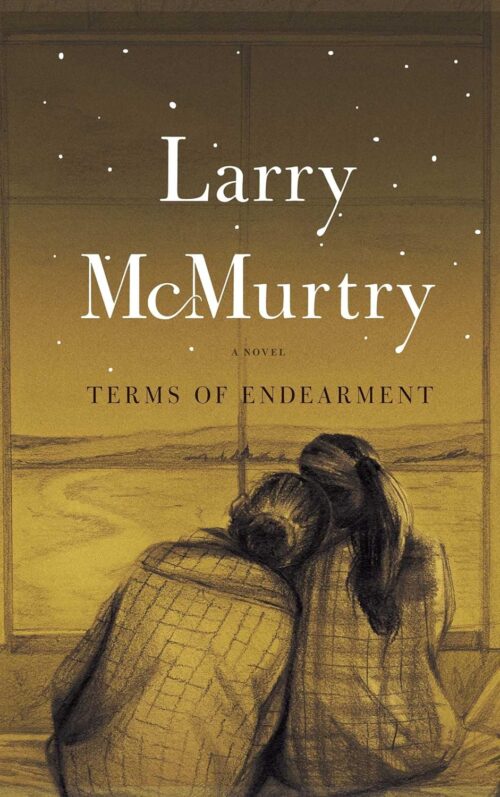
The shadow of the Best Picture-winning movie adaptation looms large over this novel, as does the specter of McMurtry’s much better novels, like Lonesome Dove.
Terms of Endearment is the story of Aurora Greenway, a widow nearing 50 who derives most of her enjoyment in life from three pursuits: driving her various suitors to distraction with her confounding, contradictory personality, meddling in her maid Rosie’s marraige to a brutal truck driver, and picking away at her daughter Emma’s insecurities. Emma is recently married to a young academic named Flap (whom Aurora cannot stand) and has just told her mother she is expecting. Typically, Aurora makes this all about her, wailing that her suitors will no longer be interested in her once she’s a grandmother.
Aurora’s suitors consist of a retired general who lives down the block with his chauffeur and his vicious dogs, a bank president who can barely form a coherent sentence around her, an opera singer who can no longer sing and is prone to prolonged bouts of weeping, and her newest beau, a fifty-year old millionaire whose inexperience around women makes him completely unsuitable to a woman like Aurora.
If you’ve seen the movie adaptation, by now you’re probably wondering, hey, isn’t this a story about the daughter dying of cancer? Well, sort of. McMurtry’s book has some of the oddest pacing I’ve ever seen. In this four-hundred page book, about 350 pages are about a brief period in which Aurora bounces between men, Rosie’s husband leaves her in disastrous fashion, and Emma starts expressing disappointment with her marriage. Then in the last fifty pages there’s a massive time jump to a decade later, and all of a sudden Emma and Flap are living in Nebraska with their two children, both of them are cheating on each other, and then Emma gets sick and dies. It’s just bizarre. Most of the stuff you remember from the movie is extracted from these last fifty pages or was invented whole-cloth for the film, like Jack Nicholson’s astronaut character.
Beyond the pacing problems, Terms of Endearment is a difficult read because of how difficult a person Aurora Greenway is. It could be argued that this is a sign of McMurtry’s artistry, but either way it makes for a bad time. Watching her mood swings, hypocrisies, and downright mean behavior is a lot to take. It’s like an unfunny joke that McMurtry repeats over and over again, to diminishing effect. I also found the book’s treatment of infidelity and domestic abuse difficult to get through. Depiction doesn’t equal endorsement, obviously, but the blasé reactions to each of the book’s many incidents of both really didn’t sit right with me.
Terms of Endearment shocked me, both in how poor I found the storytelling, and just by the sheer fact that anyone could have read this and wanted to turn it into a movie.
