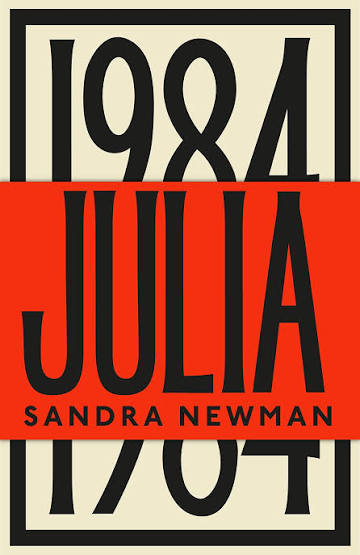
 Dystopian fiction feels very much of the zeitgeist. It’s certainly understandable as some corners of the world get darker and even the brighter ones seem dimmer. Dominant systems are pushing back on the shrinking of their legitimacy, attempting to put the top back on the Pandora’s box of equality and fairer economic systems. This retelling of Orwell’s 1984 from Julia’s perspective is very much in that vein, a misogytopia.
Like a lot of men, I like Orwell. Well, more correct to say liked than like. In my 20s, his works and life story seemed daring and different, contributing to culture in overt and implicit ways. As my understanding word the world deepened and widened I could see his underlying misogyny and classism more clearly, and this is the starting point for Newman’s reworking of 1984.
Julia in the original is very much a Mcguffin for Winston’s narrative, an icky blend of a Mary-Sue and Ethical Slut. Nothing quite like male English middle class men showing their odd sexual mores in public to make one need to scrub their soul clean. Using Julia as the jumping off point, Newman reimagines 1984 from her perspective. The narrative is different but the world feels very much the same, with not much more fleshing out of the world if Airstrip One a little to the book’s discredit. Orwell’s characters are generally ill developed, funny as they’re often stand-ins for him, but he crafts his worlds well. Newman continues that but doesn’t offer any new ideas about life in that fiction. We’re still firmly in the world of Big Brother, telescreens, and Room 101.
In some ways, this book feels predictable. The treatment of women in the book is way I expected coming into it although potentially with more superficial equality. If you appreciate 1984, it’s worth reading this as a companion piece but I’m not sure it stands up on its own.
