There’s a mystique to the worlds of libraries and librarians that pops like a soap bubble after you’ve worked in one for a while. Libraries and librarians are magic, it’s true; what most people don’t understand is that it’s blood magic.
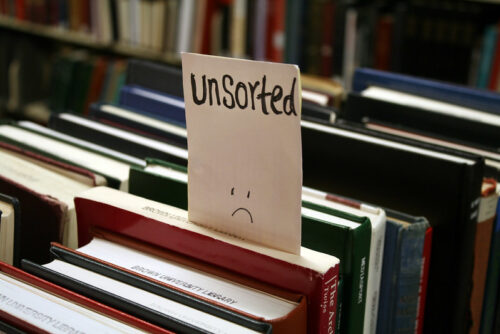
“Unsorted books make librarians sad” by quinn.anya is licensed under CC BY-SA 2.0 

 .
In the Stacks bills itself as a collection of stories about libraries and librarians, but it’s really more about the fantasy of libraries and librarians. To be fair, it was published in 2002, which means it’s as old as my career, and libraries were a lot different when I first started out. You could also make the argument that, after all this time, I have simply Seen Too Much, and cannot appreciate stories that romanticize my profession. And you’re probably right.
The stories themselves are actually quite good. While the MCs aren’t all librarians, they do all work in libraries. In some of the stories, this is important; in others, it feels as if the library setting was only chosen for romantic or sentimental reasons. Some of the librarians are stereotypical; some are not. But all of them are worth reading in the sense that they are well-constructed literary pieces that have something to reveal about human nature. They just don’t reveal all that much about libraries or librarians, speaking more closely to the perceptions, beliefs, and preconceived notions most of the authors have.
Oh well.
There were two bright spots in the collection for me. One was Gina Berriault’s “Who Is It Can Tell Me Who I Am?,” which speaks SO clearly to the heart of librarianship that it should be assigned and discussed at great length in library science programs. I’m still thinking about it. I will probably hold it in my heart like a little glowing coal for the rest of my career. I was deeply disappointed to research Berriault and learn that she passed back in 1999; I would have liked to talk to her about it.
The other was Anthony Boucher’s “QL 696.C9.” It’s a hard-boiled mystery story, and if you know even the tiniest bit about cataloging you will be able to guess who the murderer is on the very first page. I deeply appreciate the trouble he went to there, especially since LC classification is usually only used in larger libraries, and people are more familiar with Dewey. He could’ve used a Dewey number and it would’ve been just fine, but instead he went the extra mile. I also appreciated his depiction of the murderer, which was about as refreshing and unexpected as I could have asked for.
If you haven’t worked in a library, you will probably enjoy this much more than I did, which is why I went with the fairly neutral rating. If nothing else, it’s a good conversation-starter about the profession and the role it plays in people’s hearts and minds.
