Lately I’ve been finding myself drawn to dark academia, so I thought this year I might embrace it and go whole hog. I started the year off with two very different dark academia novels–one that I mostly enjoyed, and one that I didn’t really enjoy at all.
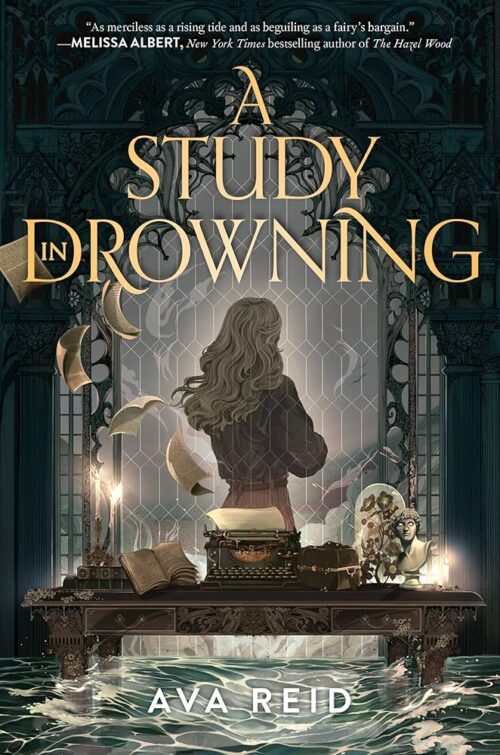
First up, I read A Study in Drowning by Ava Reid. Effy is an architecture student at a prestigious college, but she wants to be a literature student–only women aren’t allowed to study literature. Her favorite author is Emrys Myrddin, who’s recently died. Impulsively, she enters (and wins) a contest put on by his son to redesign Myrddin’s decrepit old mansion. Soon she finds herself at odds with fellow scholar, Preston, who’s determined to prove that Myrddin was a fraud who didn’t write all the works he’s credited with. Not only that, but Effy, who’s been tormented most of her life by visions of the Fairy King, finds that her visions are only getting stronger and more disturbing during her time in Myrddin’s mansion.
I mostly liked this book. There’s very little of the tedious world-building you get with so many fantasy novels, where the author spends so much time describing how everything works. Effy’s world is similar to ours, with pubs, TVs, and cars, and the magical pieces are interspersed in a way that makes it clear the author trusts you to figure it out for yourself. I liked that. There’s also a strong message here about misogyny. At times it’s a bit heavy-handed, but since I agreed with the message I didn’t mind that.
One problem that sticks out though, is why exactly Effy hates Preston so much. It starts off with her hating him because she’s jealous he’s in the literature college and she isn’t allowed to be–but it seems like the reason it especially bothers her is because he’s from Argant, which her country is at war with. She just mostly comes off as xenophobic, as Preston doesn’t do very much to antagonize her beyond merely existing. The other issue is the one that frustrates me about so many YA novels, which is that it just isn’t fleshed out that much. We learn some really interesting tidbits about both Preston and Effy, but they aren’t explored in any meaningful way. I know there’s a sequel so maybe some of that is examined there. Even though I enjoyed this book, I didn’t love it enough to read the sequel, so I guess I’ll never know.
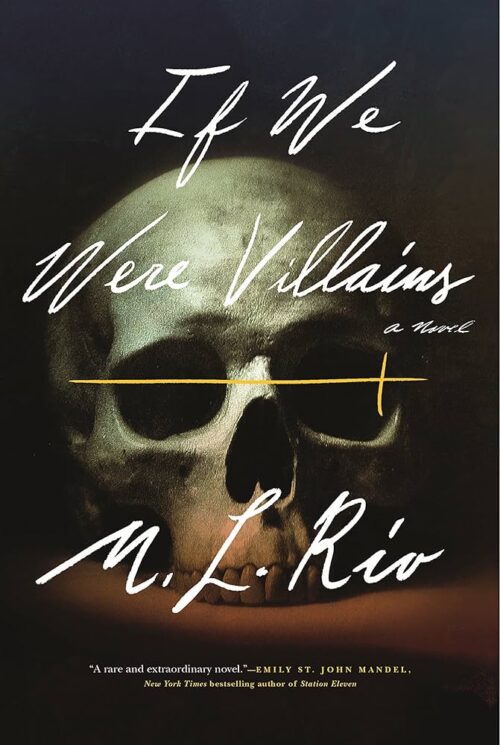
But while A Study in Drowning was mostly good, If We Were Villains was mostly bad. It starts off with Oliver Marks, on the day he’s released from having spent 10 years in prison for a murder he didn’t commit, and then flashes back to his time at Dellecher Conservatory, an artsy and elite college where he studies Shakespearean acting alongside 6 others: James, Alexander, Meredith and well it doesn’t really matter who they all are because not one of them is any sort of real character. They’re more like light sketches of potential characters: the Entitled Star, the Ingenue, the Sexpot, the Talent, the Extra, the Pot Smoker Whose Only Character Trait is Smoking Pot. The bulk of the story takes place over the first semester of their senior year, where they’re rehearsing Julius Caesar and talking to each other at length in Shakespeare quotes, as college kids do.
If We Were Villains is very, very similar to The Secret History, including the fact that the narrator is a complete blank of a person. One place where The Secret History knocks If We Were Villains on its ass is the murder victim. In The Secret History, the victim is complex and interesting, neither all good nor all bad. In If We Were Villains, the murder victim has one note–rage. At first I found this intriguing because it seemed to come out of nowhere, and I assumed that when we uncovered the facts of the murder, we’d also learn why the victim was so angry to begin with. I was wrong. This rage is never explained, so the victim falls completely flat as a character. Not only is it not surprising when they’re the one to die, but in fact it’s a relief (they’re AWFUL). But if they were so terrible to begin with, why was the rest of the group friends with them for 3 years prior to the murder? It just makes no sense.
If We Were Villains spends a lot of time with characters telling Oliver he doesn’t know anything and he’s hopelessly naive, but I couldn’t figure out what he was supposed to know. I think that one of the other characters is in love with him? But this is so vaguely portrayed that I’m not convinced. I did enjoy learning how and why the murder occurred and thought it made sense within the story, but then the book fumbles the ending in a really weird and off-putting way.
Maybe an enormous Shakespeare fan would enjoy this book. I’m sure there are plenty of Shakespeare allusions that went right over my head as I’m not too familiar with either Julius Caesar or King Lear (the play they perform during the spring semester). These two are the most heavily quoted within the text, and honestly I skipped over most of the quotes because without knowing the full context of the play they come from, they didn’t mean much to me. At one point, the students find out the cast list for King Lear and are astonished at who’s playing who. Oliver literally says, “What on earth have they done?” I don’t know, Oliver, can you tell me?? I feel like I’m fairly well-read, and I’ve read many of Shakespeare’s plays, but is King Lear really so much in the public consciousness that I should understand without being told why Oliver is surprised at who’s playing who? Because we aren’t ever told–it’s just assumed that we will understand how wild the casting is, given our collective encyclopedic knowledge of King Lear.
The more I write the more I realize I didn’t like this book, at all. Here’s hoping my next foray into dark academia is a little more enjoyable.
A Study in Drowning: 3.5 stars, rounded up to 4.
If We Were Villains: 1.5 stars, rounded down to 1.
