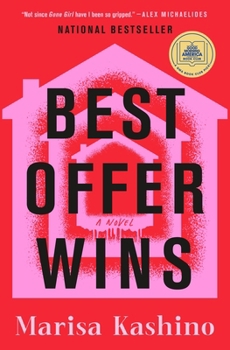
Marisa Kashino’s Best Offer Wins features one of my favorite tropes, the unlikable female main character (UFMC). Writing a UFMC is such a difficult balancing act: make her flawed enough to be engagingly frustrating, but not so flawed that the reader can’t quite believe that anyone would be willing to put up with her BS.
The Queen of UFMC is of course Amy Dunne from Gone Girl. (Spoilers ahead for Gone Girl in case you want to continue living under that cozy rock.) She is a god-tier UFMC, a true psychopath, but always compelling due to her struggles living in Missouri with her cheating lump of a husband. So many novels have tried and failed to integrate the UFMC; two that I have recently read, In My Dreams I Hold a Knife by Ashley Winstead and Migrations by Charlotte McConaghy, both commit the cardinal sin of giving no redeeming characteristics to their UFMCs and expecting the reader to accept that other supporting characters just think they are wonderful and irresistible. That’s not how the UFMC works. The UFMC has to seem like “the cool girl” (HT GG) but is really a simmering bottomless pool of “Why not me?”
Best Offer Wins succeeds by giving its UFMC, Margo Miyake, such a robust inner life and dialogue. Margo doesn’t really have friends so much as she has frenemies and acquaintances she can think mean thoughts about. It’s hard not to agree with her mean thoughts, though, because her insights are razor-sharp.
Margo also is singleminded in her goal, which is to own a house in the super-competitive DC housing market. She knows the neighborhood, the style, even the design of the numbers that announce the house address. Her obsession drives a wedge between her and her rather sadsack husband, who seems just fine living in their one-bedroom apartment for the foreseeable future. While I am not a real-estate watcher like Margo, I can’t imagine living with anyone long-term in a one-bedroom. So Margo, I kinda get it, girl.
Kashino does a great job of ratcheting up Margo’s increasingly obsessive–and eventually dangerous–behavior throughout the novel but balancing it with glimpses of her UFMC’s traumatic past that illustrate just how damaged she is. (The Blossom story from her childhood broke my heart.) Margo is a ball of anger and resentment, but I was rooting for her nearly all the way through Best Offer Wins. The novel ends much like Gone Girl (book) does: the UFMC gets what she wants, carnage be damned, and she has the last word. And isn’t the last word what all of us really want?
