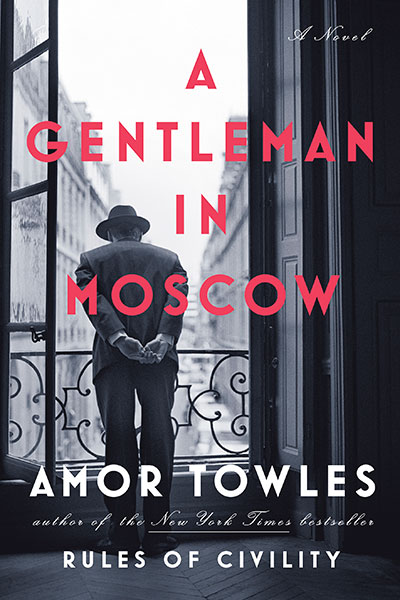
 On a beautiful June day in 1922, Count Alexander Rostov is taken from the People’s Commissariat for Internal Affairs to the Hotel Metropol. He enjoys the views of Moscow from the windows of his car. It will be the last time in decades that he is to set foot outside the doors of the hotel; the Commissariat, torn between Alexander’s nobility status on the one hand and his work as a revolutionary poet on the other, has sentenced him to house arrest. And so the count lingers in the hotel, first as its guest, then as its employee, as Russia changes around him.
There are plenty of things to like about A Gentleman in Moscow. It’s beautifully written, for one, with a cadence and rhythm and prose one might get if one translated a Bulgakov novel, for example. Alexander (referred to as ‘the Count’ in the novel) is a likeable character: observant and witty, philosophical and wizened, inventive and helpful. He is very principled, too. The biggest point of interest, though, for me personally was the history of the Soviet Union, against the backdrop of which this novel takes place. Unfortunately, that’s also the book’s weakest point.
It takes a certain eye for cynicism to appreciate just how insane the rise and fall of the Soviet Union was. Bulgakov’s The Master and Margarita, for example, gleefully toys with this, as does the brilliant The Death of Stalin. But I feel like those two are meant for people who like the cynicism. I can forgive A Gentleman in Moscow its historical inaccuracies (it’s not as if The Death of Stalin is any better in that department), but I have to be able to buy into it. This novel, for lack of a better word, is fucking twee. A figure like Rostov would’ve been shot by the Bolsheviks on day one without a second thought. But even if one is willing to overlook that, the premise is underused; Rostov, who prides himself on being a man of the world, seems both unaware and disinterested in politics even though they are happening on his doorstep; the nation’s most influential people dine at the hotel.
There are other things I don’t like, primarily the plot about the Count’s adoptive daughter Sofia, whose personality is both dull and unrealistic (Towles doesn’t appear to know how to write children, because none of them are in any shape or form believable). The plot ambles on; the novel isn’t truly boring, and I had little trouble finishing it. But it never really grabbed me either, because I kept thinking about the could-have-beens that would’ve added some teeth to this behemoth.
This novel probably isn’t that bad, but for a cynic like me it could have been a lot more entertaining.
