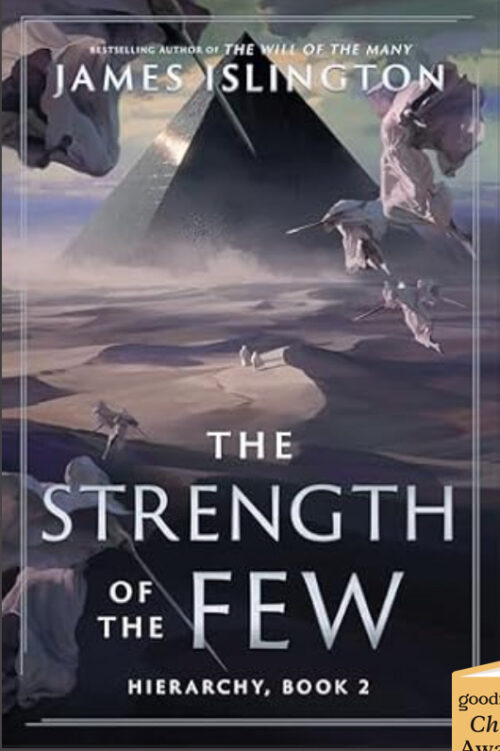
The Will of the Many was one of my favorite reads earlier this year and led to me reading Islington’s Licanius trilogy. Since I had waited a bit to read The Will of the Many, it meant my wait for the second novel was relatively short, with it being out in November.
I don’t want to get too deep into the details – there is a lot going on! Overall, I quite enjoyed it but don’t think it was quite as strong as the first novel, especially when it comes to the broader cast.
Now, there is no way to talk about this novel with a major spoiler for the ending of the previous book – to even explain the structure is a spoiler … so you know, go away and read The Will of the Many before you continue.
At the end of The Will of the Many, Vis has done what he set out to do and successfully run the maze. This leads to him being splintered into three across the three worlds – the novel proceeds to follow three different versions of Vis. It took me a few more chapters than I would like to admit to clue into the fact that the symbols at the top of the chapter represented the three worlds, all generally representative of the different cultures of those world. Plus, as it goes, Vis gains new names for each new world to further create a distance between the versions of himself.
There is the world we know already, represented by columns and reflective of a more Roman style influence. Another world is presented by the ankh with lots of pyramids so I thought of that one as the Egyptian world even if I have no clue how much it truly used ancient Egyptian culture as a basis. Finally, the Celtic world, signaled by a Celtic knot, with druids and war bands.
His knowledge of what is going on is different from world to world, and he is cut off from the other versions of himself so all are acting blindly/independently of each other to try to achieve the bigger mission, with different sets of friends, mentors and antagonists.
Since we are getting familiar with two entirely new worlds and following three POVs, there is less time to truly develop the broader cast of characters which is the biggest thing I missed here. The friendships Vis built even as he was hiding large parts of himself were such a large part of the previous novel and what made it feel so developed and created the emotional depth. Now it’s spread over such a wide range and cast that we don’t get that part quite as much.
I connected with the ankh world least – that one simply felt more clinical and scientific compared to the others, more of a wasteland in ways. Still, I enjoyed the wider development and additional world building, and the continuing politics Vis is dealing with while also being involved in a much bigger puzzle and the greater complexity of figuring out what is truly going on and what to do about it. Definitely curious to see where it goes and what the different iterations of Vis do.
