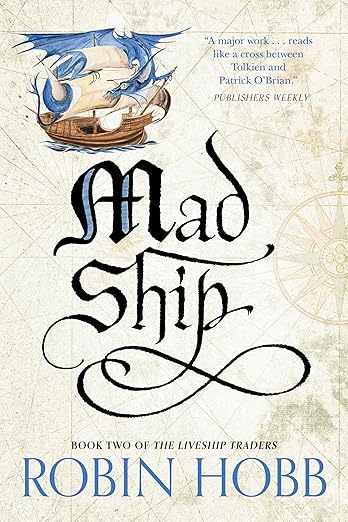
 Book 2 of this trilogy was an absolute stunner, as my conceptions of certain characters and situations were challenged and changed. Hobb continues to weave multiple complex story lines together and fleshes out her characters in such a way that I am conflicted about whom to root for or even what I am rooting for now. The Liveship Traders Trilogy is about a colonial empire facing rebellion, about a rebellion amongst Old Trader families who do not necessarily agree with each other, about enslaved and dispossessed people finding hope and strength in an unlikely savior, about strong women fighting for respect and for what they want, and about sea serpents and “liveships.” Hobb is a master at telling a sprawling, soap-operatic story in such a way that the reader is constantly engaged and not lost in an overly complicated plot or needless detail. The end of this volume was super exciting and as ever, I can’t wait to get to book three and the finale, so let’s knock this review out of the way.
It can be hard to review a book that involves so many characters and plot lines, but I am going to do my best to address major characters and their exploits in a general way. The Vestritt family is front and center again in this volume. Althea, still smarting from being denied the inheritance of the family Liveship Vivacia, has run away from home; she feels betrayed by her mother Ronica and sister Keffria, and those two soon learn that relying on Keffria’s husband Kyle was a huge mistake. Althea’s plan is to get more experience as a sailor on any ship that will take her, but given the sexism of this world, she has to disguise herself as a boy. Her travels on various ships are harrowing, but she finds herself alongside former shipmate/love interest Brashen Trell. Theirs is a complicated relationship and I appreciate that Hobb recognizes that a woman does not necessarily have to put a man and a relationship above her own desires.
A woman’s strength and desires are prominent themes in the storylines involving the other Vestritt women. Ronica, the matriarch, is still grieving the loss of her husband, but the downward spiraling political and economic situation in Bingtown forces her to step back into her strength. Keffria, who has always been sort of a shy, retiring type, also starts to grow in confidence and see more clearly the kind of man she married. Daughter Malta, who was a real pain-in-the-ass daddy’s girl in volume 1, is still being obnoxious and causing mischief in volume 2, but her story gets a lot more interesting. Malta is only about 13 and she wants the same things many girls want — nice clothes, boys’ attentions, etc, — but she is living in a world that is rapidly changing and getting dangerous. Plus, the Vestritt family has a debt to a Rain Wild family for their Liveship Vivacia. Malta is as stubborn and smart as the other Vestritt women and I really liked her story arc here.
Meanwhile, Kyle Haven — Keffria’s husband, Malta’s beloved father — is still a dick. His role in this volume is small but vile. Having forced his son Wintrow to serve aboard Vivacia, he constantly tries to beat respect and subservience into the boy. Vivacia, the ship, dislikes Kyle and wants to be as close to Wintrow as she was to Althea, but the Wintrow/Vivacia relationship is complicated. The stuff that happens to Wintrow and Vivacia because of Kyle is traumatic to read, but it sets up nicely how Kennit the Pirate can come onto the scene and seem heroic. Kennit remains one of my favorite characters. He is sneaky and suspicious of those closest to him, even though his pirates and his woman Etta are completely devoted to him. We learn more about Kennit’s past in this book. Kennit often does the right thing for the wrong reasons, which I find fascinating, and I look forward to seeing how his story ends.
This volume introduces some interesting new characters and plots as well. The Rain Wild Traders and their world are here, particularly as Malta attracts the attentions of one of the most important Rain Wild men — Reyn. Reyn has special powers and abilities related to the wizardwood that comes from the Rain Wilds and is used to make liveships. This book also introduces a new character/liveship named Paragon, who has had a troubled and deadly past. Paragon has been abandoned by his family but Althea, Brashen and Amber — a carpenter with a murky past — work to win his trust and try to encourage him to sail again with them on a mission. Paragon has PTSD, and by the end of book 2, we have some idea of why that is.
And finally there are the magical elements of this trilogy: the sea serpents, the spirit/forces that exist within wizardwood and dragons. The serpents are feared and loathed by sailors for good reason — they follow slave ships hoping for bodies to be thrown overboard to devour, but the serpents are intelligent creatures that are compelled to travel … somewhere. They are in search of their memories, which have been lost over time. They feel a connection to liveships that no one understands. The liveships detest the serpents but also realize there is some connection to them. Again, by the end of this book, we have a better understanding of what that connection is, and I have a lot more sympathy for the sea creatures that I would have expected.
The Liveship Traders Trilogy hones in on themes of colonialism, cultural appropriation, patriarchy and misogyny, as well as environmental abuses. Although the books were written over 25 years ago, their relevance to our modern world is undeniable. Over the years, I’ve seen reviewers in national publications look down their noses at fantasy fiction, but really, works like Robin Hobb’s are clearly rooted in our real world. Magic and monsters are just stand ins for power and unscrupulous people. And as ever, the monsters aren’t always the mythical creatures. Usually, they are the assholes with power.
