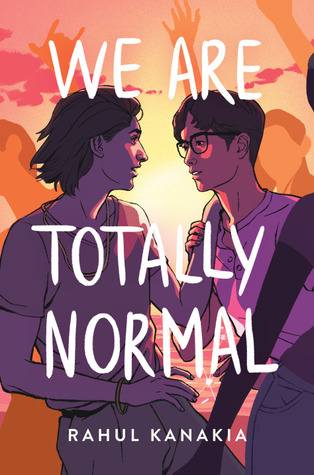
 This wasn’t really my thing (marketing fail big time), but I can appreciate it for what it was.
So, firstly, this is NOT a romance. If you came here looking for fluff and cuteness and happily ever afters, you are not going to be pleased with what you get (I suspect this is one reason for the lower ratings; the wrong audience is finding this book, and not understanding or liking what they are finding). What this is, is a coming of age contemporary Questioning novel, capital ‘Q’ well-earned, because Nandan is one of the most Questioning narrators I’ve ever read in a queer novel, certainly the most Questioning in mainstream YA. I can’t speak to the cultural or racial aspects of the novel, because I am very white and most of the characters in the book seem to be of South Asian descent, including Nandan and Dave.
And honestly, I really liked the questioning aspect of this book. Nandan was a messy, flawed narrator, whose confusion is palpable. This is not a feel-good book, either. Kanakia wanted to explore the realities of questioning sexuality and sexual identity, and in our real world, that includes “problematic” elements. Because people are problematic! There should be space for those kind of stories, too. Nandan is being pulled lots of different ways, and he doesn’t know which way to go, or even how to interpret his own emotions and preferences. He’s also very resistant to other people trying to put labels on him, even when they might be helpful (as when a friend of his suggests his response to sexual situations might be due to him being on the ace spectrum, or demisexual), because of lots of internalized phobias and shame. He’s pretty good at lying to himself.
There is a lot of nuance in his reactions to things. Take this scene after he “comes out” at school (I put this in quotes because at this point even as people begin to see him as gay, he doesn’t see himself that way, only that he is in a relationship with Dave, which comes with lots of feelings of protectiveness and affection, as well as conflicting sexual feelings). Nandan is “popular”, according to Dave, but doesn’t see himself that way, and in fact spends a lot of time in his head dissecting the social nuances of people at his school. There is a lot of conflict between the way he sees other people identifying themselves, and how other people identify him, and it bothers him that other people have images of him that don’t conform to his own, especially since everything feels so up in the air for him. Anyway, all that to say, this is an interaction between Nandan and his dude-bro friend Pothan:
His smile flickered between proud, embarrassed, and smug. “I bet you love the attention,” he said.
That made me laugh. “That is such a microagression. It’s definitely at least a medium-aggression.”
“Come off it, bro,” he said. “I know you. I know my little Nandy-poo. He’s always working the angles. He knows his shit.”
Now I smiled. “You motherfucker. Okay, okay. I don’t know, maybe . . . ”
“You love it.”
“Well,” I said. “Part of me does. But the other part–”
“No, you love it. You totally love it.”
With that, my smile faded. Pothan didn’t want to talk about anything real.
This moment is very telling for the whole book. Nandan does like the attention, but he also doesn’t. It makes him uncomfortable, and makes him question things even more. And he’s frustrated with his so-called friends a lot, for not allowing him to feel like he can really express the things he wants, on top of sometimes not actually knowing what he wants. He thinks both of those things, plus many others, all at the same time. And the book doesn’t spoon feed any of that to you, you have to parse it out yourself.
Lots of other reviews have mentioned that this book doesn’t really have a “plot,” and if you have a very strict sense of the word “plot,” that’s technically an accurate thing to say. But this is a character study, and all the movement of Nandan’s arc is internal. Nandan has a complicated relationship with his sexuality and sexual identity, and all of that is really started when he hooks up with his friend Dave; that’s the inciting incident. And he doesn’t come to any black and white answers by the end. In fact, I (and other reviewers, so I’m not alone here) got the sense that he is also secretly questioning his gender as well as his sexuality, and hasn’t realized it by the end. There are multiple instances throughout the book where Nandan expresses a yearning to be around femaleness and female bodies, in female spaces, and some of his disgust at the sexual acts he’s so conflicted about might very well be due to dysphoria. (This also makes sense in retrospect, because the author has come out as trans since the last time I looked at her author bio.)
The reason this book didn’t fully click for me almost entirely had to do with the high school setting, and the secondary characters. Nandan is friends with the popular kids, all of whom are very concerned with a lot of drama and social nuance that I hated when I was actually in high school, and still hate now. I solved this problem then by removing myself entirely from social situations that required me to perform for the approval of others, and I solve it now by trying to stay away from contemporary YA that has that drama as its focus. The one saving grace here is that Nandan is so conflicted and critical of the way his “friends” behave. He’s always wanting things just to be “chill,” and getting frustrated when their expectations of him make him feel like he has to constantly do things he doesn’t want to. I found it frustrating, too, and my response would have been to stop associating with all of these people (except for Mari and Dave) and go find the nerds instead.
Anyway, if this sounds up your alley, I urge you to check it out, because it’s a thoughtful, complex book that is getting trashed in its ratings, and this upsets me.
