
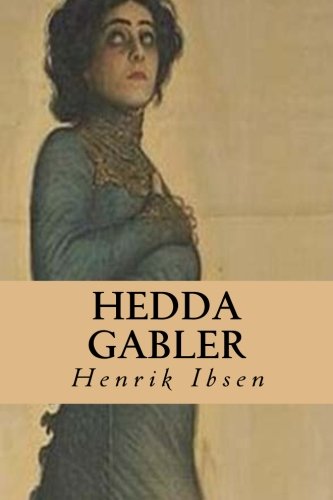
 Last year I took note of the Chancellor’s review of A Doll’s House, and realized that I had never actually read the drama, in spite of my admiration for Ibsen (An Enemy of the People was a high school favorite of mine). Wanting to rectify that, and thinking it would be interesting to also revisit Hedda Gabler, I decided to read both plays back to back and see what themes they have in common.
My conclusion is that a repressed woman in the 19th century had cause for rebellion, and she could go from doormat to “Fuck this shit” in the time it took Freud to tell her it’s not her fault she doesn’t have a penis.
A Doll’s House is the story of a husband and wife, Torvald and Nora Helmer. At the start of the play, Torvald has just gotten a new job, which means they will no longer have to worry about money, which is a good thing, because Nora has splurged a little bit on Christmas this year. “Has my little spendthrift been wasting money again?” asks Torvald. Hmm. That’s a little demeaning, but it’s not like he flies off the handle. He seems to really love her, in fact. Why, in the first three pages, he refers to her as “my little lark twittering out there,” “my little squirrel bustling about,” “little featherhead.” Geez, this guy really likes to talk down to her. It’s like she’s his own personal zoo. He’s concerned about her health, though–at one point he wags his finger at her and says “Hasn’t Miss Sweet Tooth been breaking rules in town today? Hasn’t she paid a visit to the confectioner’s?”
Dear God, he controls what she eats? Torvald makes Ricky Ricardo look like Gloria Steinem.

At least Ricky only spanked Lucy for wanting to go into show business.
In spite of the nonstop adoration she gets from her husband, Nora is anxious because she has a secret. While Torvald was ill and couldn’t work, Nora took out a loan and has been secretly working small jobs to help pay it back. Not only that, she signed her father’s name on the loan, because women could not legally borrow money. To help pay it back quicker, Nora asks Torvald to just give her money instead of a gift so that she can buy something nice for herself. It must have been humiliating for a woman to have to depend on her husband to dole out money like. . .
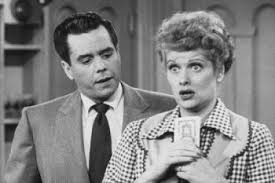
I give up.
When a man named Krogstad blackmails her, Nora is desperate. She’s convinced that if Torvald learns of her crime, he will take it upon himself, being the gallant knight that he is, and she could never allow that to happen. She even contemplates killing herself rather than letting him take the blame. So it’s a shock when Torvald does learn and, instead of coming to her rescue, declares her a miserable creature, a liar, and a hypocrite. He even declares her unfit to be a mother, saying “I shall not allow you to bring up the children; I dare not trust them to you.” When the danger passes (Krogstad sends back her bond and promises to drop the matter), Torvald sings a different tune, telling Nora that all is forgiven. “Here is shelter for you; here I will protect you like a hunted dove that I have saved from a hawk’s claws.”
Realizing that she’s just a toy to Torvald, a doll for him to play with, Nora nopes right outta there:

I read Hedda Gabler with interest because I remember reading it in college and thinking, “Wow, Hedda is such a bitch.” I was sure that being older and better able to understand nuance I’d see something I didn’t see before. Well, let me tell you, Hedda is such a bitch. But, I do see more nuance, so I guess both past and present me are correct.
Here is another play about a marriage, this one between the much-desired Hedda Gabler and George Tesman, the most boring man in Norway. George is an academic who loves his research and his aunts and his old slippers. Hedda is aristocratic and loves. . . .not really sure what she loves, but she’s certainly not interested in George’s research, or his aunts, or his slippers. Out of shear boredom, Hedda starts stirring up trouble. Her mischief ranges from insulting George’s aunt by pretending to think her fancy bonnet belongs to their servant to provoking her friend’s alcoholic lover into drinking again.

Things go from zero to evil very quickly in this play.
The alcoholic in question is Ejlert Lövborg, another academic and semi-rival to George. Hedda’s friend, Mrs. Elvsted, is carrying on an affair with Lövborg and is obviously very anxious to keep him on the wagon. Meanwhile, Judge Brack seems to have a bit of a thing for Hedda and flirts with her in a very creepy manner.
As a result of Hedda’s devilry, not only does Lövborg go on a raucous drinking-spree, he loses the book he’s been working on for ages, what was supposed to be his seminal work. Good old George finds it, but before he can give it back, Hedda suggest to Lövborg that killing himself might be the best course of action, even supplying him with one of her pistols. He leaves to do the deed and Hedda burns the manuscript.
George thinks Hedda did all this because she loves him. George is kinda dumb.

It turns out that Mrs. Elvsted had been working with Lövborg on the book, so she and Tesman decide to team up and recreate it. The Judge tells Hedda that he knows her pistol was used in Lövborg’s death and this could become quite scandalous. Unwilling to be under anyone’s control, Hedda shoots herself offstage.
Both these plays were rather shocking to 19th century audiences, because let’s face these women were out of control!

Vintage poster from 1891 Munich production
It’s hard not to analyze these plays through a feminist lens, but Ibsen denied that was his intention. Ibsen was all about individualism, though, and the women in his plays were not free to be individuals. Neither Nora nor Hedda have control of their own fates; marrying was their only feasible option. When asked why she married George, Hedda basically said, “Well, I had to marry somebody, so why not?” Neither have control of their own money: Nora forges her father’s name on a loan because borrowing in her own name is illegal; Hedda, although she grew up in a wealthy household, now has to depend on her husband for everything. Both women abandon their children in some sense: in Nora’s case, she literally walks out on them, leaving behind the life that she’s been handed; in Hedda’s case, she knows she’s pregnant when she shoots herself and wants no part of that life.
Ibsen is challenging because he doesn’t create characters that are easy to like. It’s natural and possibly even appropriate to hate Hedda, but as an American woman in 2020 I really have no idea what life was like for her. Nora is more sympathetic, but then she walks out on her children. Can we still admire her after that? Ibsen doesn’t give us a straightforward answer or even a character to root for. He’s painting portraits of individuals living in a certain time under certain conditions and how that might drive them to act. Whether we like them or not is irrelevant.
