CBR10Bingo – Listicle
I love a good list. Here’s a good list: https://tinyurl.com/y864bj7g All the books on this posting are from this list.
The Man Without Qualities volume 1 – 5/5 stars
This novel is 1700 pages and is broken up into two volumes that house three main sections. I have so far read the first volume, which has two sections, and is 700 pages long. So I am calling this as a break. The novel itself is a novel of ideas, with a heavy ironic edge to it, and is mainly about Ulrich, the man without qualities, whose qualities include a kind of intelligence, a listlessness, a refusal to be pinned down by one woman, or one career. He’s not a rake really, so much as someone who refuses, neither heroically or villainous to settle into modern life. He reminds me a lot of Nathaniel P from Adelle Waldman’s novel in this way. The novel is set in Austria in 1913, and the looming fall of the empire, an empire cobbled together from disparate parts in the first part, creates an air of “dead man walking” about everything the characters do, which includes weighing in on the ultimate fate of a convicted murderer who might be crazy or have mental deficiencies, planning “The Year of Austria” and weighing on philosophical thoughts.
Over all, the novel plays along an idea I’ve been thinking of a lot recently, about what it means to write literature in an age of disruption and annihilation, something the authors of many of these books seem to think a lot about too.
“Another paradoxical result of this disorientation is the vulgar profusion of intellectual jewelry with which our mistrust of the intellect decks itself out. The coupling of a “philosophy” with activities that can absorb only a very small part of it, such as politics; the general obsession with turning every viewpoint into a standpoint and regarding every standpoint as a viewpoint; the need of every kind of fanatic to keep reiterating the one idea that has ever come his way,like an image multiplied to infinity in a hall of mirrors: all these wide-spread phenomena, far from signifying a movement toward human-ism, as they wish to do, in fact represent its failure. All in all, it seems that what needs to be excised from human relations is the soul that finds itself misplaced in them. The moment Ulrich realized this he felt that his life, if it had any meaning at all, demonstrated the presence of the two fundamental spheres of human existence in their separateness and in their way of working against each other.”
(Photo: http://www.robertmusil.net/)
The Silence of the Sea – 4/5 Stars

In this short story, which is called a long short story, but isn’t very long, Vercors, the pseudonym of a French resistance writer, describes the specific literary conflicts of the resistance fighters, and the would-be fighters. The story begins with an introduction written, I believer by the author, but masked in a way as an observer about the power of writing from a time of conflict. I was fairly moved by this introduction, and probably more so than by the actual writing of the story, because of the earnestness and power of the symbolism contained within an English publication of a French text written, translated, and published during its occupation by the most expressly evil power in modern history. And that the story was translated not only into English, for English readers, but by famous literary scholar and critic Cyril Connolly was extra-moving. It had the air of unity against oppression, which, while real, is over inflated to the point of Nationalism in a lot of narratives. The complex nature of wartime is not so black and white.
But the story itself is more mild. It involves two primary scenes, one an encounter between a French intellectual and an occupying Nazi, and later a recruitment scene that parallels a marriage proposal. What this reminded me of most in the ways in which Fascism wants to destroy art but also co-opt it. I think a lot about where literature comes from, and while it can certainly be conservative or represent conservative values and even politics and still be quite good, it can’t be Fascist. In a similar way that I struggle more with, it can’t really be Communist either. But that Fascism abhors and completely obsesses over art in this way is really interesting to me. It’s scary as well and vulgar of course, but this is all drawn from a scene in the story where the Nazi officer is looking through a library of French literature and talking about the things he likes, and the implication throughout the scene is this moment of counterintuitiveness, where someone who wants to destroy culture is also trying to admire it, is a driving factor in the later recruitment to the resistance. Artists are revered; Fascists are scum.
(Photo: https://www.goodreads.com/author/show/102555.Vercors)
The Adventures of Tintin vol 1 (The Blue Lotus) – 3/5 Stars:

In thinking about why Tintin makes this list, is scene as a cultural touchstone, and particularly the book The Blue Lotus, it’s important to think about he concepts of touchstones in cultural lists. In a perfect world, a list like this would be completely devoid of the concept of influence and reach, and be purely aesthetic in its conception. I guess I mean so ideal, in the 1890s sense of the word. But not only is the world imperfect, and we’re all the better off for it, we also have to think about the things that sparked future works and inspired others. I think then, looking at Tintin through this lens, where you allow the work to exist alongside Proust and Joyce, you begin to see some of its additional artistic value.
These first three adventures, which are collected here, are masterclasses in cultural play. There’s absolutely plenty of racism to go around, from the depiction of Native Americans in 1920s America as if no part of American imperialism ever touched them or the literal depiction of Black Africans as pitch-black skin and ruby red lips. But what’s also going on here is the depiction of pure tropisms in the comic. What I mean by this is that Tintin exists not really in the real world, but in the world of adventure story tropes. He’s parodic in this way, teasing and illustrating the conventions of genre, while also being a pitch-rendition of them. And the writing and the stories are really fun and interesting. It’s interesting to see American pulp being rendered in Western European writing 30 year before French New Wave brought JP Melville, Godard, and the novels of Patrick Manchette.
(Photo: https://en.wikipedia.org/wiki/Herg%C3%A9)
Asterix the Gaul – 3/5 Stars:
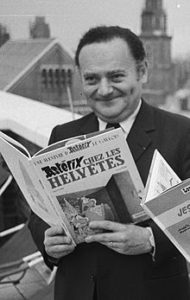
Man, I don’t know what it feels like to be French, or in this case, French/Belgian. Recently Emanuel Macron was criticized because he said the French who are resistant to change are just “stubborn Gauls” and people were offended partially on behalf of Asterix. I guess it’s a lot like looking at all Americans through the lens of Herge in Tintin in America. We’re all cowboys or gangsters (so long as you’re white and male). The fighting spirit embodied by Asterix and Obelix is one of savage intuition, a loving spirit, and a refusal to give in. It’s a very engaging and alluring set of values that is both supported and contradicted by history, and the specific recent history of France. France “gave in” to Nazi Germany, but the French Resistance became an obvious and laudable symbol against Fascism. But at the same time, the changing demographics of France as the foreign empire crumbled and receded post-war, speaks to a kind of discomfort about what it means to be French, whether that has a moral value or not, and what the historical races of France means toward a changing future. So a story of a robust French warrior, who’s also lovable and crafty, ousting and besting Julius Caesar is deeply appealing.
(Photo: https://en.wikipedia.org/wiki/Ren%C3%A9_Goscinny)
The Bald Soprano – 4/5 Stars

This play is called in a sub-heading as an “Anti-play,” which sounds very interesting of course, but maybe a little too on the nose. The story behind this play is that Ionesco was learning English through a kind of mail-order system, perhaps like Rosetta Stone, and he found the English phrasing so oddly parsed and stilted, that he wrote a play in the tone and manner of these phrases. The result is a very funny, very mundane, and very weird play in which nothing, but everything happens.
So the play is written in French and translated into English. It reminds me a lot of this video:
And the play reads a lot like a Monty Python sketch. There’s word play, there’s the use of weird common phrases and cliches. And the result is an attack on the banality of the English language.
(Photo: http://www.curiousarts.ca/exit-the-king-eugene-ionesco)
Six Characters in Search of an Author – 4/5 Stars

Sometimes you trace down the origin of an idea, or the crystallization of an idea, and while you can appreciate the influence, the sense of being first, or some other kind of enjoyment from this, but also, not be, say blown out of the water by it. I think about this in music sometimes. The Led Zeppelin song “No Quarter” feels way ahead of its time, as do many Beatles and Velvet Underground songs, but then some of the bands who maybe felt liberated by these early versions that became prog rock or heavy metal or post-punk or punk are just more clearly defined and fully realized versions. I sometimes feel David Bowie stole everything he ever did, but then perfected it (at least in the 1970s) and so no one complained.
So this Pirandello play like the play that everyone took from and improved on the form. This is a play in which the characters are the characters in a play. It’s a tropey kind of play now…where something like Black Mirror or the Twilight Zone borrows from. There’s a lot of interesting ideas, and it was most likely revolutionary in its time, but now, out of that time, it’s a historical artifact more than anything else.
(Photo: https://www.facebook.com/Luigi-Pirandello-200262456714885/)
