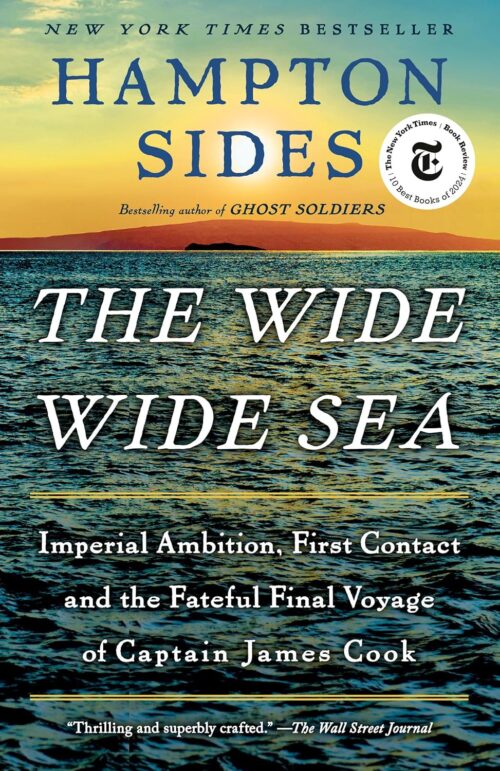
 I’ve read so much about maritime adventures this year, this seemed like a fitting continuation.
Hampton Sides describes the 3rd and final journey of Captain James Cook. Already widely celebrated – a hero, really – for his previous voyages, Sides describes how he ended up on this third journey, whose goal was to find Northwest Passage. He took the most circuitous route possible, sailing first around the Cape and then to New Zealand (!), Tahiti (!) and Hawaii (!) before making his way up to what we now call the Pacific Northwest. I know it sounds a bit silly but I didn’t realize just how lonnnnnng these voyages were. England to New Zealand to Hawaii to Oregon?! Insane. Sides describes how they chose this route, and goes into some depth about a passenger named Mai.
Mai was born on the island of Raiatea and held a deep, deep grudge against the people of Bora Bora, who killed his family in an inter-island conflict. Shortly after his family died, Mai sailed to England and caused quite a social splash, learning gentlemanly sports, appreciating fine dress and food, and getting along just fine with the ladies. Finally, as his time in England drew to a close, the King asked Cook to escort Mai back to his island home – with plenty of domestic British animals for propagation. Mai is quite a character, and I enjoyed reading about his extraordinary life. Sides does a good job of describing how Mai became almost what we would call now a “third culture kid” in a world where this wasn’t really a thing – too British to be Polynesian and too Polynesian to be British; in the end he lived alone in the only hut on his island with a lock on it.
Sides does a good job painting a picture of Cook as a personality – why he was so successful, his amazing accomplishments, and giving credit where it was due for his general policy of non-interference – a fairly progressive policy for his time, although by no means comprehensive, given the very nature of Cook’s occupation.
The saddest parts – the parts that made me put the book down to recover for a day or two – were the stories of massive violence and destruction that Cook and his men visited upon some of their ports. The introduction of black rats to Tahiti; their reign of destruction in Moorea; the violent conflict in Hawaii. All of these made me almost tear up. To think of how different this (*waves hands*) could have turned out. Or maybe not – maybe we humans are always on a collision course headed straight to violent clashes with our fellow humans. Maybe first contact will always be like this. But to think that these sailors found what they literally described as paradise, an island where fruit falls into their mouths and women willingly fall into their laps, and within days are setting things on fire and killing whoever crosses them…like, what is wrong with us?
Maybe women should have been in charge of some of these expeditions, you know? I wonder if and how it would have turned out differently…
And it wasn’t always like that – some of the first contact stories are not at all violent; some are peaceful and lovely. Sides does a good job of describing how varied these meetings were and hypothesizing about what made them so, which was interesting.
This was a good read about a real turning point in human history, an era which has changed history and put us on our present course, but also feels so far away from current day. Very difficult at times but worthwhile.
