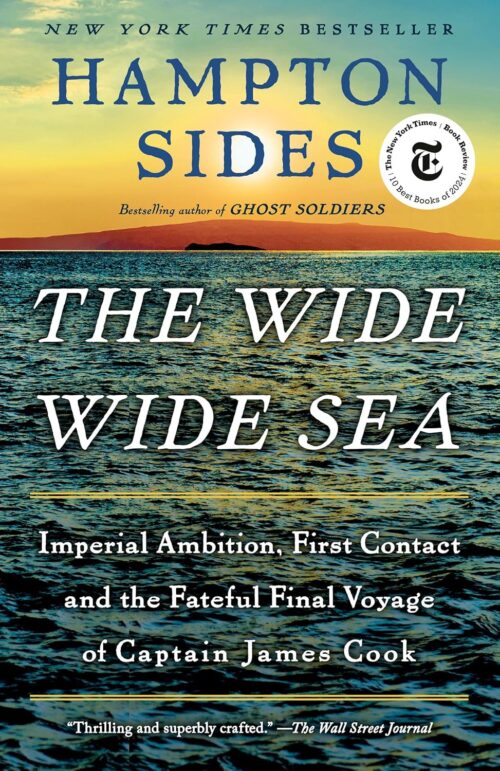
Hampton Sides is the author of maybe the best narrative non-fiction work I’ve ever read, Hellhound on his Trail, his book about the assassination of Martin Luther King, Jr and the subsequent manhunt for the assassin, James Earl Ray. I haven’t given any of his other books a try until now, largely because their subject matter didn’t seem like topics I definitely wanted to read about. At first blush, I felt the same way about The Wide, Wide Sea, which covers the third and final voyage of the famed British explorer Captain James Cook. Even after overcoming my skepticism, it took me two years and a couple of false starts before I actually finished the thing. But I’m here to tell you that I’m exceedingly glad that I did put in the effort.
Cook’s third voyage was notable for several reasons, but especially for the ambitious scope of his orders. The primary objective was the search for the much-desired Northwest Passage through North America, which, if found, could save ships a tremendous amount of time by obviating the need to sail around South America. But Cook was ordered to take a circuitous route, leaving England and sailing for Polynesia before continuing on to the Pacific Northwest and Alaska. Part of this was because of a Pacific Islander named Mai.
Mai’s story is the highlight of the early chapters of the book. Born on the island of Raiatea, Mai’s family was decimated by war with Bora Bora. Begging his way onto a British ship, Mai sailed to England and became a hit among society there, attracting the attention of King George III. Mai wished to enlist England’s help to arm his island for a new war with Bora Bora, but King George III was more interested in populating Polynesia with farm animals. He asked Cook to personally escort Mai home and deliver with him a Noah’s ark worth of domestic creatures.
Sides does a good job establishing Cook’s status with the reader, detailing his extraordinary accomplishments before this disastrous voyage. Cook had made many important discoveries for Britain, including “negative discoveries” like disproving the existence of a massive southern supercontinent that many geographers had speculated on. He was the first Englishman to reach the east coast of Australia, circumnavigated New Zealand, and charted the Pacific Northwest. He was able to do this through discipline and expert seamanship. Sides credits Cook particularly for his work in eliminating scurvy among his sailors by insisting on a well-rounded diet and cleanliness on his ship. Cook was also instrumental in mapmaking though his attentiveness to detail. Charged with possession of a naval clock known as the K1, Cook’s insistence that the clock be properly maintained no matter the weather or other dangerous conditions was of enormous help to cartographers.
More than anything, though, Sides does a wonderful job capturing the scale of Cook’s undertaking. He makes you feel the length of the voyage, the massive nature of the ship itself, replete with a society in miniature: sailors, surgeons, astrologers, carpenters, soldiers et al. Not to mention the pigs and sheep and goats and horses, etc. A remarkable number of the men aboard Cook’s ship kept notes of their time aboard, and Sides ably uses their writings to give the reader insight into who these men were.
There is also a strain of anthropology running through the book. Cook’s exploration inevitably raises questions about the costs and benefits of cultural exchange. Cook had some noble impulses, but his ships brought disease and invasive species to lands that were unequipped to deal with them at all. Perhaps just as meaningfully, the English presence among Polynesians seemed to have negative results on the islanders’ psyches. Cook and his men noted that the longer they stayed, the more the native population tended to descend into greed, theft, and other vices. Cook specifically lamented that the people he was encountering would almost certainly have been better off having never been encountered.
Sides does an exceptionally good job breaking down the voyage’s conclusion in Hawaii, dissecting the mistakes and misconceptions that lead to Cook’s demise. It’s an end that seems inevitable in Sides’s retelling, but still tragic for all it portended.
