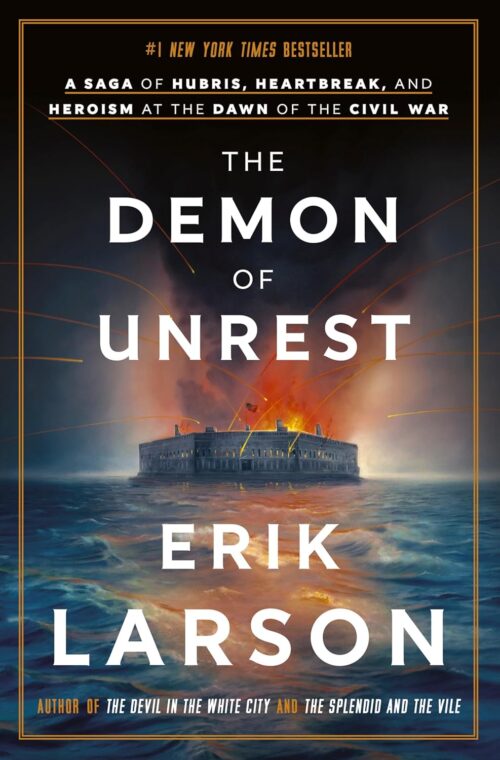
Erik Larson is the king of the “gift for Dad” genre, and nothing about The Demon of Unrest will threaten to topple him from that position. Set between the election of Abraham Lincoln in November 1860 and the attack on Fort Sumter in April 1861, the book dissects the fervor for secession and the irrational confidence of the upper class families of the South, who assumed that their region’s natural superiority to the North along with the importance of King Cotton would make a victory in war against the North inevitable.
Larson delineates Southern gentility, their outsized notion of “honor”, in contrast to the deplorable, inhuman institution of slavery. The book is thankfully free of equivocation on the causes of the war, with Larson fully indicting the South’s commitment to retaining their right to own slaves. If there is a flaw, though, it is that Larson takes it for granted that slavery’s evils are well-known and accepted that he gives them relatively little attention in his retelling of events.
A lot of the narrative thrust of the book comes from primary sources, including prominent Southerners of the day whose names have largely been forgotten. It is interesting to hear their perspectives as they stride confidently into the disastrous war. But there is little heard from the slaves themselves about the time. Perhaps there is not an abundance of such material, to be fair, but it still feels like a missing element.
Larson also covers the movement, both literal and figurative, of Abraham Lincoln during this stretch of time. Lincoln’s election prompted a vicious reaction from slave-holding states that was in many ways incommensurate with the actual positions Lincoln had taken on the issue. As the ineffectual James Buchanan finished out his thoroughly unremarkable term, Lincoln saw the crisis of secession coming before he had any power to address it, and thus began plotting the political and potential military maneuvers that would be undertaken after inauguration.
Speaking of inauguration, just getting to that date proved to be a challenge for the new President-elect. Larson details how rumors of planned attacks on Lincoln became so widespread that figures as disparate as New York police superintendent John Kennedy, mental health advocate Dorothea Dix, and famed private detective Alan Pinkerton were all separately aware of them and took steps to inform Lincoln and urge him to change his travel plans. Larson turns Lincoln’s clandestine journey into the capital into a dramatic set-piece.
Lastly, Larson also deftly covers the bravery shown by both the enlisted men and their commanding officers at Fort Sumter, who endured a grueling ordeal as the last outpost of the federal government within a state dead-set on secession.
As a final note of praise, I’d like to single out Will Patton for his tremendous job narrating the audiobook. This is maybe the first time outside of self-read memoir that I’ve ever thought that an audiobook reader actually enhanced the experience of reading the book for me.
