
On its surface, The Maiden and Her Monster is a sapphic fantasy retelling of the old Czech folktale of The Golem of Prague. Malka, as the village healer’s eldest daughter (and assistant, and second mother to her younger sisters, and professional rage machine), knows about the darkness in the woods; young women go in and they don’t come out. (Meanwhile drunken men go in and they mostly come back; the reasoning for this is barely explained except for “men are garbage”). But the Ozmini Church doesn’t care about monsters, all they care about is getting their tithe. When one of their soldiers gets murdered and Malka’s mother is blamed, Malka vows to go deep into the forest and find the monster responsible. So bringing two Ozmini soldiers, along with the village boy who loves her (and she loves; or maybe she doesn’t and will marry him to fit in with society. No wait, she loves him. No wait, she doesn’t.), she dives into the forest and uncovers a monster. Just not the one she was expecting. Instead, she finds Nimrah, a dour, inscrutable, banished golem living in the forest. She’s not who Malka was expecting, but she’s willing to be the scapegoat monster, executed to save Malka’s mother’s life, if in exchange Malka will help Nimrah rescue the rabbi who created her from an Ozmini prison. Of course, with this being a Dark Romantasy, there turns out to be an even bigger threat that must be faced, and will force Malka to decide what matter more to her: her people, the person she’s risking everything to save, or the feelings that are growing for the very creature she was taught to fear (which is the golem, if you can’t decipher Romantasy speak).
Total candor: The paternal side of my family is Russian Jew, with my grandfather coming from a family of Orthodox, where most of the men became rabbis. Myself and one of my cousins call ourselves “Mudbloods” because we are pretty much the only children whose parents are not both Jewish. Dinners with my father’s side sound like the scene in Annie Hall with Alvie’s family (and with my mother being a WASP, dinners with my mother’s sounded like Annie’s family). I didn’t have a bat mitzvah solely because my parents raised me in a non-religious household (my father is a cultural Jew; it was my mother, the Agnostic Episcopalian, who had to tell him what a chuppah is during their wedding planning.) This is a very long and meandering way to say that when a cousin handed me this book to read, saying that she wanted my opinion as it was “just too Jewish” for her, it was a bit of a shock. Worse, she was right:
This book is just too Jewish. It is so very, very, very, very, very stereotypical Jewish.
Which if you know anything about Yiddish/Hebrew/Judaic customs, you’re set. If you don’t, you’ll have a hard time sussing out what is based on reality and what is an author’s invention. The book I read after this one, When the Angels Left the Old Country, included a glossary in the book of Yiddish/Polish/Russian/Hebraic terms; this book would have benefited from one as well. Also, her choice of what words she used versus what she just describes was interesting; chupa (I always heard it as “chuppah”, but maybe there are cultural differences) and kugel she just uses, but she calls challah “braided bread” instead. But to be frank, there was no way that the source material could be anything other than Judaism. Or should I say the story, because as much as Martinez tries to claim that this is set in a fantastical world. this is Czech Judaism with a thin veneer of the fantastical over it. To be honest, until I read the Author’s Note at the end and realized that this was based on The Golem of Prague, I thought this was set in Russia, and kept visualizing Malka’s village as Anatevka from Fiddler on the Roof. Even the attitudes; most of the village is wandering around all but singing
, except for Malka’s father, or Abba, just reminded me of Crazy Rich Asians.
So we’ve got two movie references already, and I wasn’t even thirty pages into the book. By the end, Sever, the Ozmini Archbishop and main villain, had me round it up with Ladyhawke

Malka and Nimrah, who should have been the stars and the characters I wanted to read about the most, I just hated. I hated their relationship, I hated them on their own, I hated their dialogue, I hated their angst, I hate the fact that what should have been a great love story turned out to be “other than the author has determined it why are you two together? You have nothing but misery, distrust and maybe some lust between you.” Though to be fair to them, there isn’t one character I actually like in this book; they all annoy me in various new and interesting ways. For people who talk about how selfless they all are (especially Malka) and how much they sacrifice for everyone else (especially Malka), and how no one appreciates or notices how much they suffer and sacrifice for everyone else, giving up their own happiness so others don’t have to do without (Malka, the point of being selfless is that you don’t tell anyone you’re being selfless), these people have got to be the most selfish, self-absorbed, “hooray for me and screw everyone else” group of people I’ve read about in a long, long time. We hear about the hardships in their village. (Suffering!) We hear about the drunk ineptitude of most of the men. (Suffering!) We hear about how women are disappearing. (Suffering!) We hear about how the Ozmini church and its followers are bleeding them dry, abusing them, and attempting to eradicate their religion. (Suffering!) But their faith is strong enough that they will all pull through, because what is their religion if not persecution and suffering, but with the hope that one day things will get better. (But always, always, always,
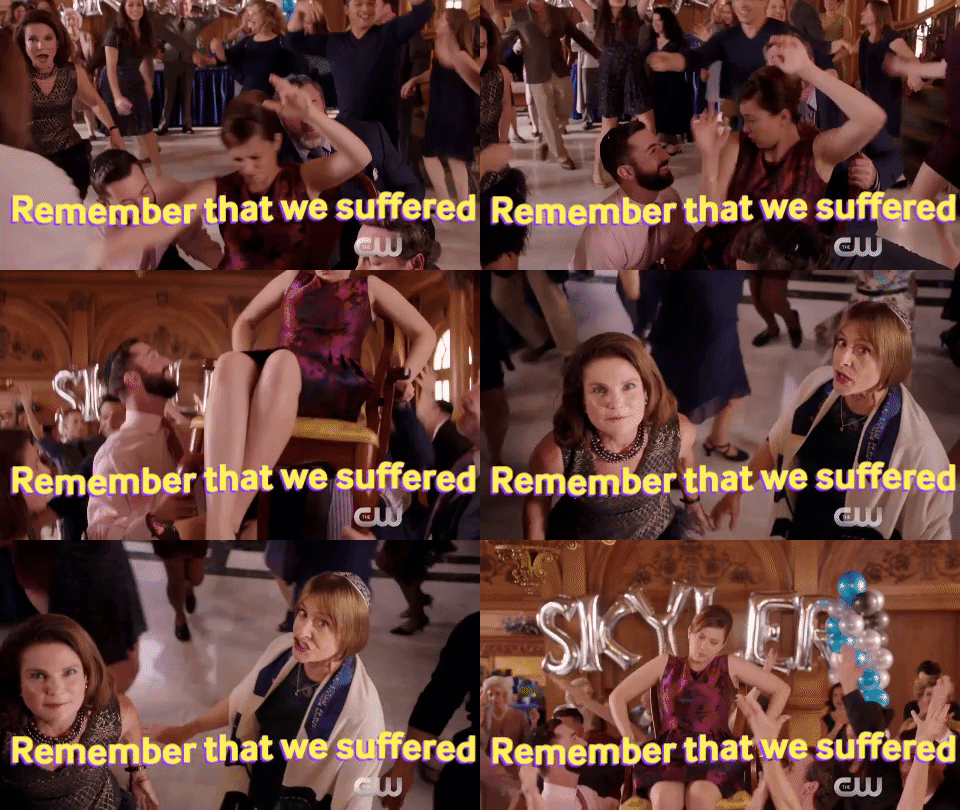 )
)
Seriously, if there was ever a happy moment in all this depression don’t worry; either the characters or the author would take it out and shoot it. I’d say everyone has a martyr complex, but that would maybe take away from the fact that almost every character in this book comes across as someone who thinks things might one day (if they have enough faith) get better, but on that day they will cease to exist, because what else will they have to live for? But hey, at least everyone has absolutely no problem with lesbianism, so they have that going for them. There is only once I truly felt for Malka; a scene where she’s having a near panic attack and the person causing it has the entire reaction of

(To be honest, there was a Gahan Wilson cartoon I wanted to use here, but seeing as it involves an aged Hitler with a swatstika armband, I thought it might be a little bit in bad taste.)
Despite all this, I can’t say the book necessarily sucked; it was just extremely difficult to get through. To the extent that it took me six days to get through, mostly because every couple of pages I had to put the book down and detox before I yeeted it through a window (or startled my mother by snapping and inarticulately screaming).
So I guess I don’t recommend this book. Or maybe it’s not great, but something that if Sapphic Dark Romantasy is your tea you might want to read once. This is probably one of the few books I can’t come down strongly one way or the other. (As snarky as I have been about it.)
