 Rating:
5 Stars
In a nutshell:
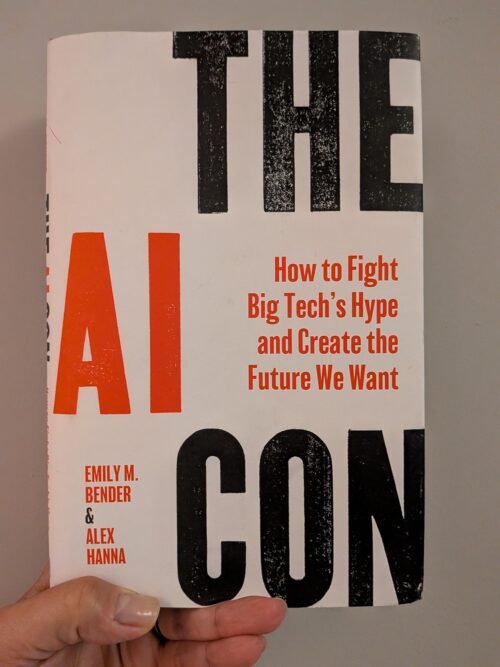
Experts in the field Bender and Hanna explore all the issues with AI – from what falls under the category, to how it impacts real people, and how we can demand better.
Best for:
I think this should be mandatory reading for anyone who uses ChatGPT to write an email. Or any executive who claims their company should be ‘AI forward’ (whatever the fuck that means).
But also, it’s great for folks like me who have a reputation for hating all things generative AI, because it helps temper that anger with some actual support for my rage and concrete actions to take.
Quote that made me think:
“ChatGPT is nothing more than souped-up auto complete.”
“When executives are threatening to replace your job with AI tools, they are implicitly threatening to replace you with stolen data and the labor of overworked, traumatized workers making a tiny fraction of your salary.”
“…the need for advancement for future white people at the cost of Black and brown people in the here and now.”
Why I chose it:
This was a gift from my partner. I chose to read it in March but got sidetracked (plus it’s a hardback and those are a pain to travel with), then decided I needed to dive into it and properly read it.
Review:
I am not knowledgeable when it comes to tech. I mean, I can figure out some things with a bit of a search, and I manage to run a little wordpress site thanks to templates and some help from my very tech-savvy partner, but I am definitely not someone who is interested in having the newest, the best, or the shiniest when it comes to technology. But I have always had a full on hatred for generative AI. Unfortunately, I work for an organisation that is constantly pushing for AI use (of all varieties), without in my opinion spending nearly enough time critically thinking about what they are using it for and why.
Which is concerning, since I work in higher education.
This book is so well-written because it is accessible to someone like me, who needs a few things explained, but also has a little bit of understanding of how things work. And I appreciate very much that the authors have actual experience in the field – they aren’t just folks shouting from the rooftops, fighting the inevitable. They’ve worked in AI, and they are well aware of all of its flaws, as well as the narrow ways in which it might be beneficial for use.
The introduction starts off strong, listing out and defining all the different activities that can fall under the concept of AI. I think many of us use generative AI (e.g. ChatGPT) and AI interchangeably, but not all AI is ChatGPT. The next chapter focuses on the hype, and debunks it. It’s important here to point out that the authors are not saying that generative AI is not harmful. What they are saying is that it is actually a bit ridiculous (it is a ‘synthetic text extruding machine’), it certainly can’t do everything its promoters say it can, and the harm is not that it’ll take over and kill us all Terminator 2 style, but that it is ALREADY harming us in the everyday.
The next chapter focuses on the use of AI at work, and points out the reality that writing is part of thinking creatively – thinking and writing are not two separate activities. So if you outsource the writing to an LLM, when are you doing the thinking? I related to the idea that if someone I work with can’t be bothered to write something (relying instead on automated text extrusion), then why should I be bothered to read it?
Another chapter looks at the dangers of using different types of AI in social services. Chatbots make things up, give people shitty information. AI in healthcare leads to huge errors – United Healthcare’s predictive model had a 90% error rate. And companies are selling off tasks that should be performed by humans to companies that use machines to do it instead. The authors here argue that especially in these fields, the humanity is a necessary part of the service, and it cannot be outsources to a glorified text autofill program. The same can be said for industries like science, art, and journalism, which they also explore at length.
I especially found the penultimate chapter to be enlightening, because this is where they discuss how the AI Doomers are focusing on the wrong thing – as noted above, the concern shouldn’t be AI becoming sentient and ruling over us all. And framing that as the biggest concern actually helps promote AI, because it gives it way more credit than it deserves. And the boosters of AI overstate dramatically both what AI can do now and what it can do in the future. This is also where the authors talk about the actual, imminent, real harms AI is causing, to labor, to the environment, to water usage. As an example – Google’s indirect emissions have gone up 48% since 2019 – and that stupid AI overview that pops up when you use Google these days is estimate to use 30x more energy than just their regular link return.
The final chapter is one of the longest, and I love that because it focuses on actions we should be taking to fight the hype and prevent AI from invading all of our spaces. The focus is on asking questions of any AI system being promoted: what is being automated? What goes in and comes out? Can you connect the inputs to outputs? Are these systems being described as human – and if so, why? How is the system evaluated? Who benefits? Who is harmed, and what recourse do they have? How was it developed?
They wrap up with a focus on regulation that is needed – both the enforcing of existing laws and regulations, and the creation of new ones.
As you can see, I thought this was a great book, and I encourage anyone who loves AI or hates AI to pick it up.
Would I recommend it to its target audience:
YES
