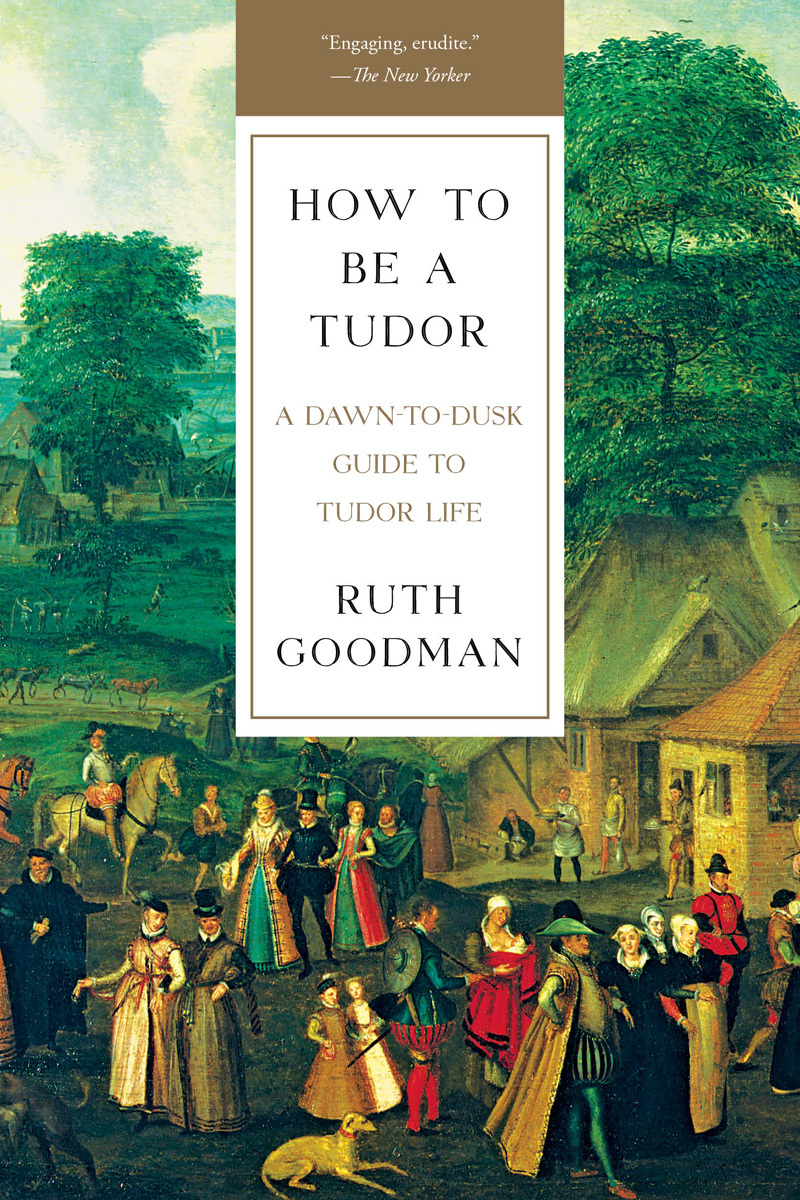
This is a day to day, dawn to dusk guide to Tudor life that barely touches on plague, and doesn’t at all touch on the dangers one faced during the yo-yo religious times, or Scotland trying to (frequently) invade Northern England; in fact, she barely touches on religion at all (while bringing it up almost every chapter; the largest being the one on sex). Yet Protestantism isn’t a real religion, the poor are poor, yet can afford vast amounts of imported goods for their culinary arts; clearly consistency is the hobgoblin of small minds. You also get a leisure chapter with no mention of falconry, horseback riding, croquet, bowling, or board games; but this covers all leisure activities available in Tudor England. (No need to differentiate Tudor-Era Wales, Scotland, or Ireland, because apparently they were all part of the United Kingdom at the time and all interchangeable.) And I hate to tell her, but not every Protestant was a Calvinist; heck, quite a few weren’t Lutherans either; yet she strongly insinuates that all Protestants had the view that someone, somewhere was dancing, and they hated every moment of it.The author also completely ignores Cambridge, Oxford, Eton; or that under Henry VIII and onward, there was a large push for education of the masses Henry VI started it; it just apparently went away in between.
If you ever wanted instructions for them, this book will tell you how to make Tudor-era ink, bread ovens, neck ruffs, two women’s hairstyles, and several other things; all of which she does perfectly, as does her daughter. Who is, of course, being her daughter, as talented, historically obsessed, and perfect as her; I don’t think Goodman would allow her to exist if she wasn’t. The one activity she tried and wasn’t very good at, archery, she condemns women doing as it’s “not particularly lady-like.”
Great that it’s working-class heavy (because the nobility are too popular in literature/Goodman thinks no one wants to read about people of a different social class than they would be), but it’s more like yeoman farmers and below that class-heavy. She’ll state one thing and then pages later write something that contradicts the first, and just never mention it. Once again, just like in her How to Be a Victorian, this is a surface-skimming book for the mildly curious, not a historical deep dive. You would think she might have mentioned childbirth practices (but perhaps the opinion was probably they didn’t happen every day), more in-depth medical info, or maybe even a short paragraph on popular names at the time; but I guess that wouldn’t fit into this book too well. If nothing else, it might take away from her apparent love affair for Desiderius Erasmus; she mentions him in this book on par with Henry VIII, and more than Henry VII, Elizabeth, Mary, and Shakespeare combined. (That’s okay, she mentions Thomas More once, and that’s discussing the flowering shrubs he grew under his study’s window.)
But I suppose I’m just asking for too much minutiae historical information from a woman who claims she’s all about the minutiae historical information of the “average, ordinary, common” type of person living an “average, ordinary, common” type of life.
In a gripe about this edition’s printing decisions, not the author’s decisions; once again, just like in How to Be a Victorian, the US printing makes every image black and white, so it’s very difficult to see details in most of the images (where she really wants you to observe the details).
I was mildly annoyed by her in How to Behave Badly in Elizabethan England, though it was still a fascinating book. I found her reasonably enjoyable in How to Be a Victorian; in fact, there was very little I found to fuss over. This book, however, had me slamming the book down often to vent about how she’s entitled to her opinions, not her facts. Which really annoyed me because as I said, I like her Victorian book; it was fascinating, she had an informative but not dry writing style. I wanted to keep reading that book, so how I felt about this one is more of a letdown then it could have possibly been.And what makes it worse, is that Tudor England is the time period she’s more enthused by, the one that she would live to go back and live in. If this is you passionate about a subject Ruth Goodman, then maybe stick to writing about the things you’re less inspired by.
After How to Be a Victorian, I planned on picking up the rest of her books; after this one, I think this will be the end. Especially since the only other book of hers that is readily available is one that apparently goes into how much life and cooking went downhill when we went from indoor wood fires to the coal stove. Or maybe it’s the fact that she is once more person in a line of people who firmly insist that not only was Elizabeth I the worst ruler England ever had (when they’re not claiming she was just a dumb, mutton dressed as lamb figurehead for the male advisors in her life), but also England went down the rails when the Great Reformation occurred and they gave the Pope the boot as their religious leader. And what annoys me in some ways most of all is that even with all this grousing, I still managed to fill 7 3×5 index cards front and back with new information; true, some of it is venting about her choices (or her opinions), but it’s still 7 cards. Now I just have to wait to see how much my mother (who Majored in History, specifically English History) is going to argue vehemently with the book. So the fun isn’t over yet.
