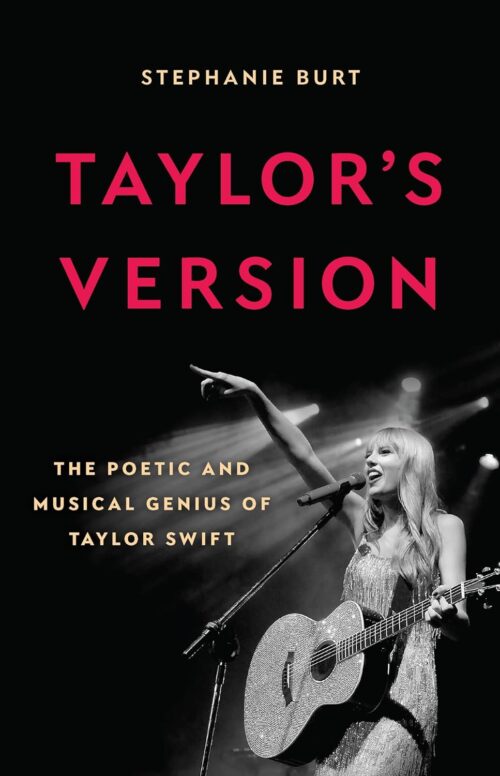
At the absolute peak of Eras Tour mania you might have seen a news story or two about Harvard offering an entire course just on Taylor Swift, Whether you reacted to that bit of information with derision or envy is probably pretty strongly correlated with your ability to sing along to the bridge of Cruel Summer, but in any case, this book, Taylor’s Version: The Poetic and Musical Genius of Taylor Swift, is written by the professor who taught that course.
As such, Burt tends to keep her focus on the music itself, weaving in biographical information and Swift’s romantic life when it has bearing on the work. To a non-expert like myself, Burt appears to have a strong command of both music theory and poetics, breaking down the way Swift’s melodies and lyrics both contribute to her project. Burt’s main thesis is that Swift’s incredible success as an artist is that she has managed to position herself as both an aspirational figure and a relatable one. Even as Swift’s actual life has become unrelatable to the ordinary fan, her emotional reactions, Burt says, are still recognizable to fans who aspire to her dazzling life.
The book is sensibly organized in a way Swifties will find familiar, with each chapter corresponding to an album, or “era” if you prefer, with an extra chapter tacked on covering the Eras Tour itself. (Notably, this book was published before the release of Swift’s latest album, the modestly-received though commercially successful The Life of a Showgirl.)
As someone whose own Swift fandom only dates back to the pandemic albums Folklore and Evermore, I found the early chapters illuminating, filling in details about her early career and first few albums. However, as the book progressed and I found that I knew more about the eras being covered, my interest in Burt’s analysis flagged quite a bit. I also felt that her interest was running low, as her arguments became repetitive with the same points coming up over and over again. I also found some of the later chapters rather skimpy on coverage of individual songs. Whereas nearly all the tracks on her Debut album and Fearless received attention, the 31-track double-album The Tortured Poets Department received comparatively scant analysis.
The book seems to be caught in the middle between trying to be a serious academic undertaking suitable for people genuinely interested in the poetic and musical analysis while also appealing to fans who are more interested in which songs were inspired by each of Swift’s boyfriends. In its efforts to play both sides, Burt’s book may ultimately wind up as something unlikely to fully please either.
