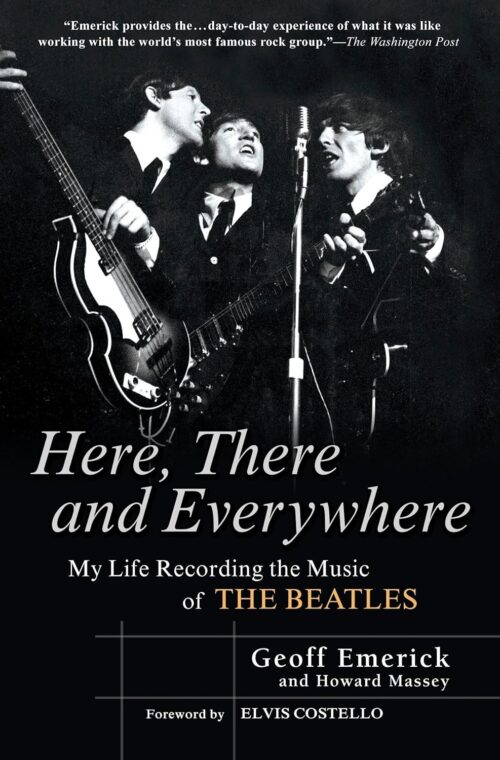
This is the story of Geoff Emerick, the sound engineer who worked on some albums for a little band from Liverpool you might have heard of. Emerick was in the studio with The Beatles almost right from the beginning, first as an assistant and later on as the chief engineer. His timing was incredibly fortuitous: on just his second day at EMI, he was told to shadow a more senior employee for a nighttime recording session for a new band that the label had just signed.
As remarkable as that is, the most incredible aspect of it may be Emerick’s age at the time. He was just fifteen years old. Having left school with no chance at a university education, Emerick stumbled upon the idea of trying to work in the music industry, desperate to avoid following his father’s footsteps as a butcher. Lacking the skill and talent to make it as a musician, he set out to become an engineer and miraculously landed at EMI.
After dispensing with this brief bit of background, Emerick wisely sticks mostly to what it was like working with The Beatles. His account of the recording process is replete with amusing anecdotes, such as an early session devolving into chaos when the bands crazed teenage fans stormed the building and could not be contained by EMI security officers.
As Emerick rises up the ranks at EMI he becomes more involved with The Beatles, while The Beatles coincidentally are getting more and more interested in sonic experimentation. Their infamous decision to stop touring and become a studio act freed them from having to consider making their songs replicable for a live audience. The band became obsessed with distortion, feedback, and countless other innovations that stretched Emerick’s skill and bent all the rules at stuffy old EMI. Though the technical aspects of overdubs, eight-tracks, and other tricks of the trade might be a little outside the reader’s purview, the liveliness of Emerick’s account can carry the day. Much of the book is imbued with this sense of putting you in the room with the band.
However, Emerick’s account of this time period is also clearly quite biased. He is unabashedly closer to Paul than to the other Beatles, and tends to take Paul’s side in his reportage of any disagreement between Paul and John or anyone else. Emerick is also frequently, and I would say strangely, antagonistic towards George Harrison, who he describes as sullen, moody, and annoyed by his “kid-brother” treatment from Paul and John. Emerick is also frequently dismissive of Harrison’s musicianship, mentioning his struggles with nailing guitar solos and inability to compete as a songwriter. It’s a lot to take for those of us with a fondness for “the quiet Beatle.”
Emerick’s account of the late-period squabbling between the band members across the recording of the White Album, Let it Be, and Abbey Road will be a major source of interest to fans, though his account is blinkered by his limited perspective. He was not privy to conversations outside the studio, but luckily for the reader plenty was going on in plain sight. That includes, of course, the increased presence of Yoko Ono. Emerick has little to no dealings with Ono herself, and his account largely places blame on Lennon for being so insistent on her being in the studio as opposed to blaming her for the issues her presence caused. Taking Emerick at his word, his straightforward recounting of events is still fascinating.
Overall, the book is a bit too long and marred by it’s transparent bias and limited perspective, but for the true obsessive, the level of detail on the recording process makes it a must-read.
