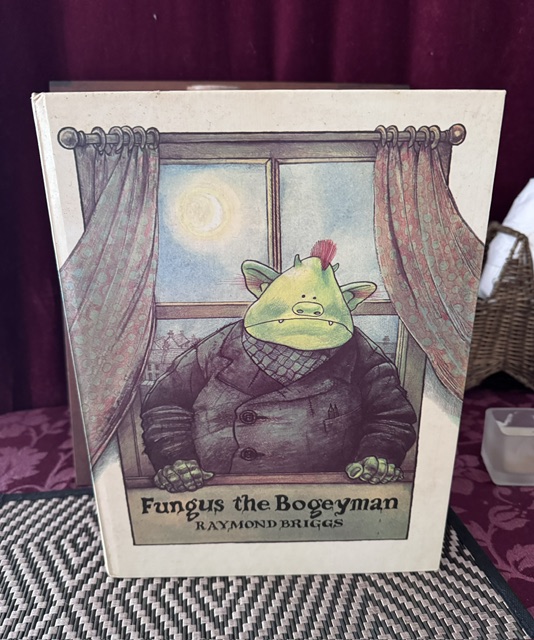
 Raymond Briggs’s Fungus the Bogeyman is one of my favorite books of all time. I came across it at my grandparents’ house when I was about 10 years old. It is an illustrated book about the daily life of a bogeyman, Fungus, and his family. Along the way, we learn about bogey life, which is simultaneously thoroughly disgusting and charmingly sweet.
The book is a day in the life of Fungus. His job, like other bogies, is to travel at night from the bogey life underground to the upper world, where he terrifies the Drycleaners (humans). As the day progresses, there are many asides that explain bogey life, especially as Fungus uses his bicycle to travel to the surface, passing many bogey doing things like fishing (the goal being not to catch a fish), boating (where the goal is to not travel anywhere), playing games (tiddly winks made of dried mud which break apart every time you use them), pig sticking (an ancient game where bogies stick pigs to muck-covered walls and the last one to have their pig fall is the winner), cowpat gatherers, and landmarks like a movie theater that treats audiences to bad smells rather than films.
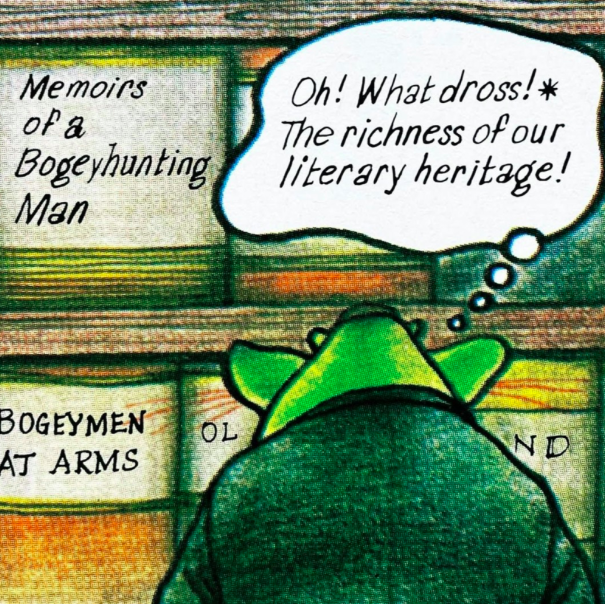 Above ground, Fungus harasses and frightens humans by tapping a branch against the window, creating bumps in the night, hiding behind things and jumping out, disturbing babies in their crib, slowly turning door knobs from outside bedrooms, lurking in windows and the bogeyman’s art, creating boils while humans are asleep.
Daily life is described in detail, from the bogies’ need to have everything wet and slimy–from their clothes to their beds–to the rotten food they eat, to the constant striving to keep the house filthy and bug-ridden, to bogey ablutions (all of which involve making the bogey more disgusting).
There is a ton of humor in the book. One of the things that cracked me up is the bogey tendency to think in nonsense or misquoted quotations. Graffiti is made up of similar quotes, rather than anything scatological. As Fungus goes about his day, he also muses about the purpose of scaring humans. He basically has an existential crisis about the meaning of his life and work. He tries to talk about this with his wife and other bogies, but no one can understand this line of thinking.
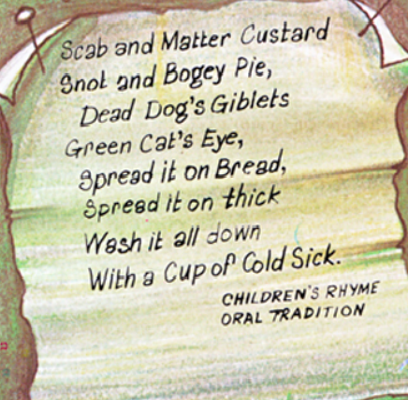 Other characteristics of bogey culture are sprinkled throughout. Special bogey words are defined throughout the book, from the affectionate terms of drear and direling, to grume (a viscous fluid) to stercoraceous (made of dung) to the saying “boibye” to wish farewell. Bogey life is very quiet and any noise is an anathema to bogies. Which leads to a very funny sketch of young bogeys who rebel by listening to raucous rock and roll and staying clean and dry.
The book isn’t terribly long, but it’s so much fun (and gross). I used to own a pop-up version of the book, but I lost it somewhere along the way. I lament its disappearance.
