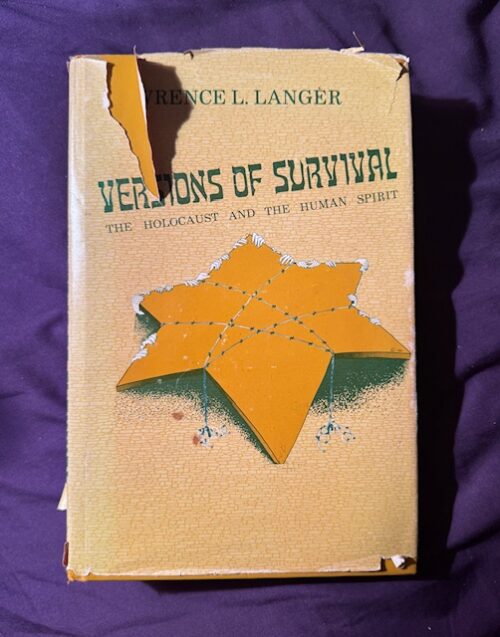
 Lawrence Langer’s Versions of Survival: The Holocaust and the Human Spirit is one of the most brilliant books on the Holocaust I have ever read. Langer tackles the meaning of survivorship in the death camps, using language as a lens to examine the experience of atrocity and annihilation and those that did and did not survive.
Langer divides his book into four sections: Language as Refuge; Auschwitz: The Death of Choice; Elie Wiesel: Divided Voice in a Divided Universe; and Gertrud Kolmer and Nelly Sachs: Bright Visions and Lamentations.
In the first section, Langer introduces his critique of Frankl and Bettelheim’s version of Holocaust survival, where “man’s search for meaning” has nothing to say about who survived and who didn’t in the camps. Langer criticizes the language of “heroic gesture” in the face of annihilation. He says:
Instead of altering our perception of moral reality, [the authors] try to adapt the fact of extermination to ideas of suffering and heroism that have governed man’s secular or religious faith throughout the Judeo-Christian era. Authors like Victor Frankl and Bruno Bettelheim, whose works on the subject are among the most widely read and often quoted, seem unwilling to abandon the possibility of individual choice and heroic gesture even in the extreme situation of atrocity, although evidence, including some of their own, repeatedly undermines many of their conclusions. Is it an image of man they are loath to sacrifice, or an image of themselves?”
Langer looks with skepticism on the idea that a survival based on moral practices is the most meaningful or true version of Holocaust survival.
In the next section, Langer focuses on Auschwitz and what he describes as “choiceless choice” in the camps. He grapples with the idea that choice could be meaningful, dignified or redeeming in the face of terror and death, where in fact inmates survived or didn’t based on mere chance and for no reason. He relates heartbreaking stories of prisoners taking on horrific actions that bely any sense of inner freedom, such as a woman who kills another mother’s new baby, as mothers and newborns are cast into the death chamber together. In order to save the mother’s life, the woman prisoner takes the life of her child. Langer points to such events as the “choiceless choice” inmates faced. He objects:
The abomination of extermination cannot be diminished or obliterated by laudatory verbal formulas about the task of suffering, the power of inner freedom, the opportunity for choice, or the spiritual or biological triumph of survival.”
In the section Elie Wiesel: A Divided Voice in a Divided Universe, Langer examines Wiesel’s writing to examine how the author turns between language and silence, between meanings of survival and the endless dark. Langer argues for the Holocaust as the great divide in language: from pre-Holocaust ideas of meaning to the post-Holocaust annihilation of language itself as a way to describe the horror. He points out that “Wiesel ridicules, by implication if not intention, the thesis set forth by Frankl, Bettleheim, and others that it was possible to live in the camps and afterward by values inherited from one’s precamp existence.” Langer examines Wiesel’s exploration of the survivor’s ties to the dead, and how in much of Wiesel’s literature the main character is often a “prisoner of the dead” and their annihilation.
The final section focuses on poets Gertrude Kolmar and Nelly Sachs. In Kolmar’s poetry, she writes of transcendence in the face of the Holocaust, which Langer contextualizes by pointing out Kolmar lived in Berlin as a laborer, but wasn’t exposed to the life in the camps until she was deported to Auschwitz and was never heard from again. There is no post-camp change in her poetry because she died there and no poetry existed after she was deported. Langer does not criticize Kolmar for her pursuit of spiritual survival, but he contrasts her poetry with that of Sachs, who lived through the camps and whose poetry is much more dark witness without majesty or vindication to soften her vision. Langer goes into very deep literary analysis of each writer’s poems, and I confess I got rather lost in the end.
As Langer himself states, “one of the main themes of this study [is] the inadequacy of our verbal and spiritual resources to express and transcend the wound of atrocity.” He goes on:
A major challenge of Holocaust art, especially visible in Nelly Sachs’s poetry, is to project from the very spaces between words (and images) a resounding silence that ‘engages’ the reader and compels him to acknowledge and confront what is not said, not only by the poet, but even more by the tongue of the victim who can no longer speak of his doom.”
I can’t really give justice to Langer’s work here, as his brilliant analysis of versions of survival is too sophisticated and original for me to fully convey. But the book is a fascinating look at different ways of speaking–or not–of the atrocities of the Holocaust.
