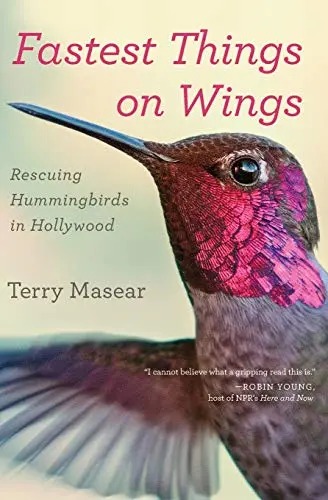
 In spite of being a fervent animal lover, I rarely read animal-centric memoirs, and I’m especially avoidant of ones with “rescue” on the front cover. I find these books are generally either too depressing, too saccharine, or they are written by dedicated, well-meaning individuals with questionable writing talent. So when my husband brought Fastest Things on Wings home from one of his Little Free Library jaunts, I eyed it with suspicion. He read it first and assured me there were just a couple of heartbreaking bits (and he’s even more sensitive to that type of thing than I am), so I decided to give it a go. Not only did this book overcome my concerns, it left me metaphorically soaring.
Author Terry Masear has been rehabilitating hummingbirds in Los Angeles for more than 20 years. She and a small network of rehabbers in Southern California have helped to rescue more than 10,000 hummingbirds, as well as field countless phone calls from panicked animal lovers concerned about distressed hummingbirds in their area. In Fastest Things on Wings, Masear recounts how she first got involved in hummingbird rescue (it always starts with that one injured animal) and describes an array of beautiful, fascinating, and sometimes comical experiences. She’s also a former professor of English as a Second Language at UCLA, so I needn’t have worried about subpar writing. Her prose and story-telling ability are top notch!
I’m not going to lie, there are a couple of heartbreaking encounters; you have to understand that going into a book about rescue. Overall, though, this book is rife with optimism, not just because of all the amazing work that Masear does, but because it turns out that most people are decent, at least when it comes to hummingbirds. True, some people are beyond selfish. Masear describes what philosophers call unenlightened self-interest: “A few callers refuse to do anything, even when they created the problem and circumstances require little of them. They call only to angrily demand that somebody else spring into action. Some people won’t take five minutes to save a life, regardless of the minimal investment it requires.” But so many other callers will go above and beyond, like the woman who climbs out on a tree branch overhanging a rocky shore to retrieve an orphaned baby, or the parking valet who runs into the middle of the road to rescue a hummingbird that slammed into a limo, and then takes a series of buses to bring said bird to Masear’s house. The stories of people going out of their way for these delicate flying jewels outweigh the ones about self-centered jerks who think it’s somebody else’s “job” to do all the saving (for the record, Los Angeles Hummingbird Rescue is entirely volunteer-driven).
Anyone involved in animal rescue of any kind is sure to love this book. While some of Masear’s interactions with people are infuriating, some of them are hilarious and others are bizarre. She sometimes finds herself in the position of therapist, as with the caller who incorrectly insists that a hummingbird mother “isn’t fit” because she’s not spending enough time with the babies. (Reader, she was spending exactly the right amount of time with the babies. This caller clearly had a lot of emotional baggage.) In another only-in-LA encounter, a caller from Beverly Hills insisted he couldn’t drive to Masear’s house because he was the butler and was preparing for a dinner party, and nobody else could come because they were all very busy (at least they had the good grace to slip Masear a hundred dollar bill to cover expenses).
Masear sprinkles in just the right amount of information about hummingbirds, so if you’re not a fan now (and if that’s the case, really?), you are sure to become one by the end of the book. For example, she explains how, during his courtship dives, a male Anna’s hummingbird travels at 385 body lengths per second. While peregrine falcons are technically the fastest animals (traveling 240 m.p.h. during a dive), when you measure in body lengths, hummingbirds “travel almost twice as fast, making them the fastest things on wings.” She also takes the opportunity to educate the reader on the concerns that some callers express about whether they should interfere with nature, or “let it takes its course.” Some reluctant interveners even suggest they are weakening the hummingbird gene pool by interfering. Masear adeptly counters that 1) there’s nothing natural about Los Angeles and 2) many of the baby hummingbirds that reach her rehab end up there because someone trimmed a tree, making the babies victims of carelessness, not weakness. Finally, she posits, “Next time you are lying in the hospital facing certain death without medical intervention, ask yourself . . . how important your life really is in the big scheme of things.” God, I love her.
While Masear avoids anthropomorphising (both in the book and in her rescue life), she does form special connections with a few birds, including Garbriel (rescued by the aforementioned parking valet) and Pepper, who was injured on a film set (and fell into a dish of jalapeños). The interconnected story of these two hummingbirds is so moving I got teary at the end (I’m not generally a crying reader).
Animal rescuers are in a class by themselves. I know quite a few and have tried to support them here and there, but I know I would be a failure if I ever tried to get involved on a larger scale. An opossum rehabber I know once asked whether she could release an opossum in my backyard, to which I readily agreed. This was a “soft” release, meaning the opossum was kept in a cage for a couple of nights to acclimate to the yard, with me leaving food for him. After 2 or 3 days, I was to open the cage door at night, and let him leave on his own schedule. The morning after I left the cage open, I approached it with trepidation. Seeing he had left, I started bawling from that mixture of relief and sorrow that must be an almost permanent emotional state for rescuers.
This book is almost as wonderful as its tiny flying subjects, and I can’t recommend it enough.
