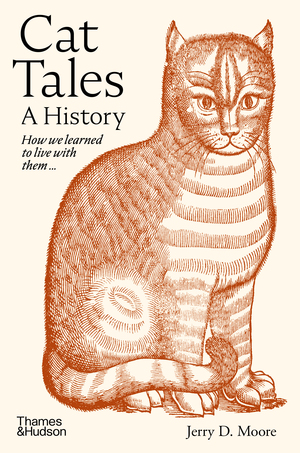
 I love this cover! It’s an illustration from Edward Topsill’s The History of Serpents, or, the Second Booke of Living Creatures, printed in 1608. If you could see it in person, you’d love it even more, because it has a metallic finish. A book with a cover like this will practically jump off the shelf into your hands.
I love the 76 photos and illustrations throughout the book, which range from more historical illustrations to photos of mummified animals to a famous photo of P-22, Los Angeles’s most famous mountain lion. I could sit and soak up these images all day.
I love the introduction, which gives a brief synopsis of the human-cat relationship in a tone that is accessible and inviting.
I was sort of underwhelmed by the rest of the book.
I hesitate to disparage Cat Tales, because I have a feeling that I’m not the right audience. On the other hand, I’m not sure who the right audience is, if it’s not a cat lover who also enjoys science writing. On paper, I seem to be just the type of person this book was written for, but instead I found myself bored and unable to retain any information as soon as I turned a page.
This breaks my heart, because cats are fascinating creatures. This book aims to follow the path that felines took to “domestication,” which doesn’t seem to be the correct word. In most instances of domestication, humans breed animal for particular useful traits; cats, on the other hand, sort of just showed up in response to the presence of a reliable food source (the house mouse, which showed up in response to stored grains). It’s also curious that, in spite of there being many species of small wild cats, “only one species, the African wildcat (Felis lyrics) is the ancestor of all domesticated cats.”
Author Jerry D. Moore is an archaeologist, so perhaps you need to be hardcore into archaeology to appreciate his writing style. For example, when he describes an important dig site, he’s careful to provide measurements and locations in great detail (at 3.7 to 3.8 meters, x was found; a few centimeters higher at 3.35 to 3.5 meters, y was found; at 3 meters. . .and so on). I’m not faulting him for being accurate; that type of thing isn’t terribly engaging to me.
He also uses a lot of words to get to a single, tenuous point. He goes into great detail, for example, describing the brutal treatment of elephants in ancient Rome not only as war machines but as victims of bloody “hunts” in the Colosseum. For several pages he describes the capture and transfer of elephants across the Red Sea as well as a scene from a Roman circus so gruesome that the normally bloodthirsty Roman audience was disgusted by it, to end with the conclusion, “Thus, it is somewhat surprising that the people of Berenike were apparently sentimental pet lovers.” It felt like quite a long tangent to get to that “hmm” statement.
Tellingly, the quotes on the book jacket are from a Professor of Egyptology at the American University in Cairo and a Distinguished Emeritus Professor at UC Santa Barbara. So perhaps I’m correct that ideal audience is an archeology student.
All this leaves me uncertain how to rate this book. It will be good as a reference source, and I’m going to keep it on my shelf if only for the wonderful cover and illustrations. But it doesn’t seem to be the right book for your general cat fanciers, or even your general cat fanciers who like science. Perhaps the archeology or anthropology major in your life will love it–it does, after all, have a lot more to say about humans than the title implies.
(Rating for me is about a 2.5; I’m sure it’s a 4 or 5 for somebody out there though.)
