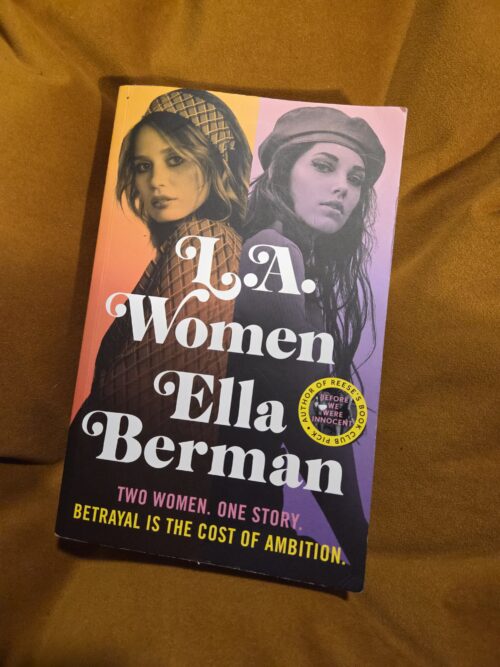
 I picked this book up because I liked the font, and the colours, and I’m fascinated by Los Angeles (where, of course, I’ve never been), and its foggy shadows and neon gleam: the films, the music, the messy myths and sprawling stories. The story here is a little Natalie Beach/Caroline Calloway if they lived in the 1960s-1970s, haunting Laurel Canyon instead of Cambridge and New York. Berman’s story centres on Gala and Lane, the friend with the glitter, the friend in the shadows, and the lability of these roles. It does tap into a theme I find hugely interesting, which is the contested terrain of whose story belongs to whom, the crackling fence between my story and your story. I’m basically weirdly into the intense relationships between people who devour each other, especially for Art, I think.
I liked this book, and the way it dealt with this, but I didn’t love it, and sometimes those are the hardest reviews to write. But if you enjoyed Daisy Jones & The Six by Taylor Jenkins Reid (2019), you’ll probably like this.
Lane has broken her writer’s block by writing a book about Gala, and Gala is sick of being a muse, sick of having her life story captured and re-framed. Because after all, there’s not much difference between a myth and a cliché, and Gala, as a woman who sleeps with rock stars, and inspires rock anthems, and parties hard and crashes into addiction, is perilously close to falling into the latter.
Lane wants order in her life; she needs her secrets expertly airbrushed, her lavish parties carefully orchestrated by her friend Charlie, a PR expert (I do wonder if people talked about ‘building a brand’ in the 1970s quite as much as Berman thinks they do?). This restraint spills over into Lane’s writing–Gala has to remind her that readers want stories about humans being human. Lane’s novel, infused with Gala’s confessional honesty, becomes a big hit; meanwhile, Lane inspires Gala to write, to become something more than a muse for men who don’t really care to see her. Then Lane starts writing a book about Gala, but Gala has disappeared.
There are moments where this is all intriguing:
Perhaps Lane could invent an ending, and this version of Gala would end up like so many L. A. women before her–violet and vomit-streaked in a stranger’s bed at the Chateau. or maybe she would buy a baby grand piano and move to the coast to start over, bright-eyed and sober with a new sense of wonder for the world. Either of these options might be satisfying if Lane could just find the words. It was never meant to be a biography, so what does it matter if she’s liberal with the truth? Only every time Lane tries to write her way to the end, nothing seems to work. Gala’s voice is suddenly too syrupy, too knowing, the jokes contrived and corny, and Lane can no longer capture Gala’s inimitable mix of warmth and savagery at all. The sentences are stiff. Unusable. (111)
The problem with writing about writers, however, particularly successful writers, is that describing their style doesn’t actually say very much without examples from what they’re writing–and the problem with hyping characters up as talented writers is that the examples inevitably fall short. But the other trouble is, neither Lane’s writer’s block and identity crisis, nor Gala’s ‘inimitable mix of warmth and savagery’ come across fully in the text. Lane is a control freak who has problems embracing motherhood; Gala is a flake who tries to mother her damaged boyfriend. The ways in which they need each other and hurt each other are fairly predictable, if beautifully written at times. The problem is also that acknowledging clichés isn’t enough to avert them.
I’d read Lane’s book about Gala, I think, but here there are several layers of sanitising and distancing from the characters–there’s a jumping around in time, there’s a weird switching between present and past tense, and we’re paradoxically told too much. Everyone’s motivations and interiority are revealed, so there’s not much mystery, and where there’s no mystery there’s no myth. Myth-making itself is a fascinating process–the falling apart of a myth in a cataclysmic orgy of flame and darkness is also fascinating, but here things just end not with a bang but a whimper.
Title quote from ‘L. A. Woman’ by The Doors (1971)
