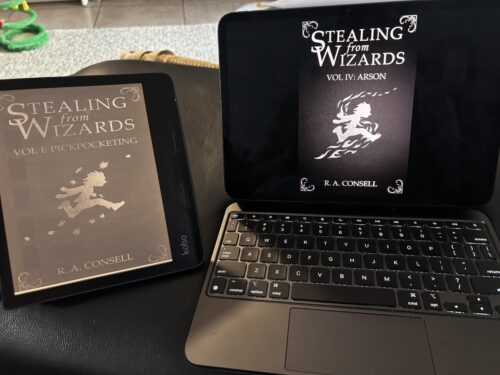
Not the one you think!
At this point I may as well admit my problem is not reading the books, it is writing these posts.
It’s been a bumpy year for me and I hoped that a much anticiapted trip to Japan would help (in November). But instead I got to find out that my role at work was being eliminated, in a Teams call while on holiday. (It’s ok, I have a new role as part of the same restructure, but I didn’t know that at the time). The bright spot was being able to start reading the last book in this series the next day as it was published! Not a prefect replacement, but a good distraction at a moment when I needed one, and a satisfying conclusion.
Stealing from Wizards is a middle grade series I discovered courtesy of Epcot, some years ago. It focuses on a student at a Canadian magic school and is written by a Canadian science teacher with a fondness for cosplay.
Vol 1: Pickpocketing
Kuro is a young boy, who is a servant/slave for an evil wizard. He knows he is a created person, because of the wizard telling him, he knows he is a disappointment because he doesn’t have much magic. He runs errands for the wizard, which at this stage involves him begging and “borrowing” food and drink in a wizard town centered at the meeting point for a number of fairy roads. Kuro and his master live on one of these, Detritus Lane, which is where lost/broken things end up. That they live in a hovel and have to beg for food and drink is a source of rage for the wizard- once he had power and wealth, but those have slipped away. When Kuro was young there was a tutor/carer for Kuro, but she escaped and then the wizard police (the Hounds) came for them.
The first few chapters set the world for the books, and Kuro’s life. I like that the worldbuilding doesn’t explain everything – it references places and has a few details in context (market stallholders selling items from various areas) but doesn’t tell me everything. There is a larger world out there, but because Kuro doesn’t know or care about it- the reader does not get the detail.
One day he comes home and Phineus(his master) has disappeared- the Hounds have raided their flat. He struggles to survive- bound by a number magic commands, fending for himself requires finding their loopholes- but carves out a space for himself. Then one day he interrupts a burglary at a shop where the shop owner has been kind to him. He is “arrested” by the Hounds and is enrolled at the wizarding school.
Kuro sees this as a form of arrest/holding and is distrustful of his enrollment. He already knows he is not good at magic. He makes friends (and has at least one antagonist ) and struggles with his studies. His background becomes an issue with other students.
Kuro is already familiar with the world of magic- his challenges are in the practicality of interacting with other students, getting to live a normal chalidhood and social interaction.
What I appreciated about this: it is a magic world, with thought through elements that are not necessarily spelled out. The Chekov guns are fired, but sometimes they are hiding as one part of the story until they go off in a different direction. (Trying not to spoil here, but there are elements that are introduced in book 1 that pay off in book 2 or 3). Kuro survives the final challenge through clever use of the skills he has and the relationships he has made.
Vol 2: Burglary
Book two starts in the orphanage Kuro now lives in, studying to pass the exams that will let him progress to year 2 of junior high school.
Year 2 is when the students learn how to summon their familiars and this takes up a significant part of the story as Kuro and his friends struggle to do so. He is blamed for a number of mysterious break ins across campus, and is working with his friends to work out the real culprit.
He goes to stay with his best friend for the wizard version of Christmas (Solstice) at a farm in the western wild lands and learns some important things about himself and about his history. I am being vague here because it is a lovely tie in with information from book one and to how he interacts with the world.
In the end he finds the source of the break ins, which indicates that the long lost heir to the Summer Court is a student at the school. But who it is remains a mystery.
Vol 3: Kidnapping
Leading into year 3 of junior high school students ae starting to deal with hormones and relationships – although Kuro is a bit behind on this. There is also increased speculation about the heir, and a number of activities to find this person.
As part of the process, Kuro must engage with the families of two of his friends and there are some really interesting links and stories. These indicate that the adults have their own histories and stories that are not always articulated.
The heir is found, and is subject to a deeper plot that Kuro must rescue them from – after which he runs away.
Vol 4: Arson
Year 1 of high school (3 year high school in Canada?) and there are a lot of changes. More hormonal and relationships issues, that Kuro is largely oblivious to/incompetent at. Changes in relationships as a result of the Heir being found.
Kuro has to cope with have a very big secret he cannot share with his friends that has implications towards the end of the book.
Ultimately it ties together several threads that have been running through and ends satisfactorily – while he must have completed the last two years of high school, these do not appear.
What i appreciate about the stories is the power of owning and acknowledging mistakes and error s of judgement. There are multiple characters who are able to reflect on their past behaviour and make changes (there are also those who don’t). There is discussion about being coerced into problematic behaviour that is nuanced and considered.
The relationships of characters may be opposite or same sex, and carry no judgement or value on either. Kuro is blindsided by one, but it has more to do with seeing one of his teachers as a person in a relationship, rather than who it is with. There is at least one character who transitions in the background – and it is not a big deal, more of a comment on recognising who they are. They are fairly minor though. There is another character who can be fluid in how they are, and they simply are, although there is some discussion, as there are a Changeling, about their gender preferences and how they present. Note- not as in a very special moment in the novel where we talk about gender presentation more as someone comments about returning to their “true form” and they note that no one knows what the true form of a changeling is- it could be purple skin and spikes. Given the other wizarding school books and the authors current stance, i suspect some of this may be a reaction, but the subtle approach is refreshing. It normalises it without indicating that it is special that both participants in a relationship are the same gender.
Kuro is going on a hero’s journey, but it is one that is a reflection of himself. This means that he does not gain significant magic skills- he applies the ones he has, and uses the advantages he has but knows that he will never be immortalised as a statue.
The ending wraps up the big story of why there was political upheaval and mischief- but it is not for significant political reasons- it is the result of a misunderstanding of how a particular process worked and an a very unhealthy obsession. The clues are layered into the books, so that when you get to that point it is a moment of oh, of course that’s why that was not as predictable and yet makes so much sense.
These are lovely books, make for a nice diversion and the author reads them in a free podcast if you want to dip your toes in before buying them. I think they might be self published or small publisher- so not in bookstores so much.
