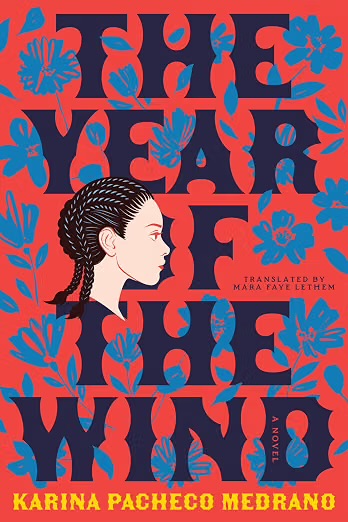
 Cbr18bingo Sheep. Sheep and other livestock are mentioned throughout the novel and sheep feature prominently in a particularly important scene
Earlier in the year I reviewed Rabih Alameddine’s brilliant novel The True True Story of Raja the Gullible (and His Mother) and one of the things I noted in my review is that the narrator, who is a few years older than I am, describes growing up in Lebanon and Beirut in the 1970s/80s. I was in high school and college at that time, and while I remember hearing about awful stuff happening there, the novel really clarified the political situation for me and how it affected the people. The Year of the Wind by Karina Pacheco Medrano does the same thing for Peru in the 1980s. When I saw this book on the shelf in the library, I was drawn in by the blurb, which indicated that this was going to be a story that involved the Shining Path, a terrorist/revolutionary group that I remember hearing about on the news in the 1980s. Karina Pacheco Medrano was a child in Cusco in 1981 when the story of a student being tortured and murdered by the police for suspected involvement in the Shining Path hit the news. The student was innocent, but Pacheco Medrano indicates that this event was a watershed moment for her, an end to innocence, and it is part of the story of main characters Nina and Barbara, cousins whose lives are forever changed by the political upheaval and violence that swept through Peru for decades.
Nina, the narrator, is already 50 when the story opens. It is a month before the pandemic hits and she is on a 6 month sabbatical in Spain, working on translations and writing her own stories. While at a market one day, she hears and then sees a woman who could be her cousin Barbara’s clone. She hasn’t seen or heard from Barbara since about 1982 but was told by family that Barbara had fled Peru for Brazil to pursue her dream of studying veterinary medicine. When she approaches the woman, it is clear this woman does not want to talk to her, but she bluntly tells Nina that Barbara is dead and has been for a long time; her name is Berna and she has no interest in speaking further to Nina. Nina slips one of her cards in Berna’s bag and hopes she will reconsider and call.
After returning to her apartment, Nina starts thinking about the past. We are then taken on a journey to Peru at the end of the 1970s, when Nina, a 10-year-old, spends the summer in the country with her cousin Barbara, who is 16, and Barbara’s grandmother Bernardina. Bernardina has a small farm in a mountainous region where she grows corn and raises livestock. During summers, Barbara helps her out, and Nina has happy memories of spending time with them. Barbara comes from a large family that struggles financially but the children are all very intelligent. She shares her dreams of flying away and seeing the world and challenges Nina to come out of her shell, to be less fearful. Later, Barbara will move to Cusco and live with Nina’s family while attending school. Through Nina’s eyes we see Barbara’s ambitions and frustrations and her growing involvement in student protests. Cusco, like many Peruvian cities, had been shielded from the unrest developing in the rest of the country, but that comes to an end in the 1980s. The Shining Path was a group of rebels who engaged in acts of violence and destruction in more remote areas — blowing up bridges, killing local officials — and allied themselves to the poor and indigenous people. In response, the government sent police and military forces to suppress the Shining Path. In more remote regions, outside urban areas, locals found themselves stuck between opposing violent forces whose point of view was that if you are not actively supporting us, you are with the enemy. Tens of thousands of people disappeared and died during the next decades at the hands of both the Shining Path and the Peruvian government. Barbara was working as a teacher in one of the most violent areas when Nina lost contact with her.
Now, in 2020, Nina is desperate to get answers. Is Barbara alive or dead? Did she make it to Brazil? Why would she not have sent letters to let Nina know where she is? Nina makes a decision to head back to Peru for a couple of weeks in order to investigate. She knows where Barbara had worked and she has a copy of the official government Truth Commission report on the atrocities committed from 1980 into the 1990s. As she investigates she discovers that some people are evasive about events of that time and about Barbara in particular. Barbara’s family are all gone, either dead or having moved away, but those who knew them have conflicting stories about what happened to Barbara. Nina’s return to the area where Bernardina had her farm, to the place of Nina’s happiest memories, leads to some disturbing discoveries and more questions.
This novel contains passages of genuine horror. There are descriptions of torture, rape, and death, based in reality, that can be hard to read. This is an outstanding read though and I highly recommend it. In between chapters, there are bits of poetry, perhaps the ghosts of the past trying to speak to Nina, that are both beautiful and sad. Translator Mara Faye Lethem seems to have done an excellent job with this novel.
