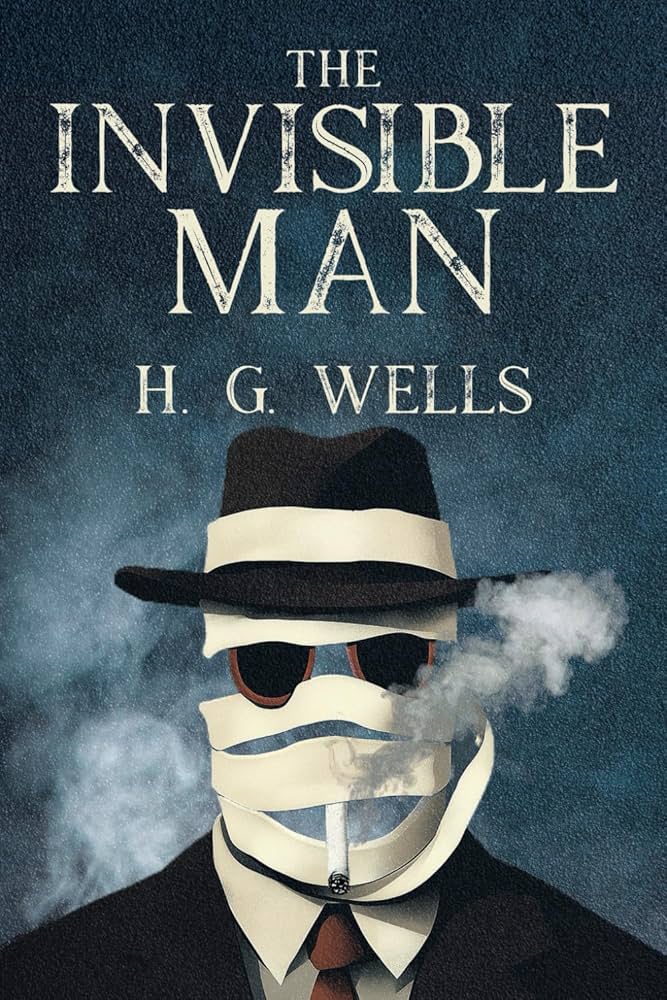
 Sometimes the idea of a story is a thousand times better than the actual story, as is the case with H.G. Wells’s The Invisible Man. I look at that cover and think, “This is going to be one badass book–a fun, light read that will nevertheless leave me pondering the nature of loneliness and isolation.” (Okay, I didn’t get all of that from the cover.) With fewer than 200 pages, this book turned out to be an unexpected slog and I’m still not sure what happened.
A man covered head to toe in bulky clothes and bandages shows up at an English Inn and demands a room. He’s kind of a jerk from the beginning, but his money’s good, so the innkeepers give him an isolated room and promise to leave him alone. He gets very tetchy whenever anybody disturbs him, and when the innkeepers complain about him causing damage to their property, he just tells them to tack it onto his bill.
Initially, everybody thinks that he must be horribly disfigured, and Mrs. Hall, a stereotypical Nosey Nelly, tries to pry out of him what happened. She mentions a carriage accident that happened down the road, hoping the man, whose name is Griffin, will open up to her, but the fellow doesn’t bite. At one point, she sees Griffin sitting in front of the fireplace, and her eyes play tricks on her (so she thinks), “But for a second it seemed to her that the man she looked at had an enormous mouth wide open–a vast and incredible mouth that swallowed the whole of the lower portion of his face.. . .Then he stirred, started up in his chair, put up his hand.” When his money runs out (curiously, around the same time there’s a robbery in the village) and the owners start asking more questions, he gets fed up and reveals his invisibility: “Then he put his open palm over his face and withdrew it. The centre of his face became a black cavity. . . . They were prepared for scars, disfigurements, tangible horrors, but nothing! The bandages and false hair flew across the passage into the bar, making a hobbledehoy jump to avoid them.” (Ok, credit where credit is due: I just learned the word hobbledehoy.)
So far this sounds very interesting, but this all happens in the first third of the book. The rest of the novel is Griffin running around invisible with villagers unsuccessfully trying to catch him. Turns out Griffin is an albino scientist who made himself invisible and hasn’t figured out how to reverse the process. He’s always been lonely and isolated, and there’s a great analogy to be made there; I simply found Wells’s writing boring as hell. Scenes that should have been funny fell flat for me, and scenes that should have been exciting were dampened by Wells’s choices to switch perspectives at odd (to me) moments.
I’m always a little heartbroken when I don’t enjoy a classic. I appreciate the inventiveness of Wells’s idea and the place The Invisible Man holds in literary history. It’s the kind of idea that can be played with endlessly, which explains why it’s been adapted into many films over the last 120 years (including the 2020 version with Elisabeth Moss, which is completely unrecognizable from the original tale but is a perfectly decent airplane movie). It’s a short read, so if you want to satisfy your curiosity, you won’t need to invest that much time. Unless, like me, you find Wells’s writing tedious.
